
 By Archie J Abraham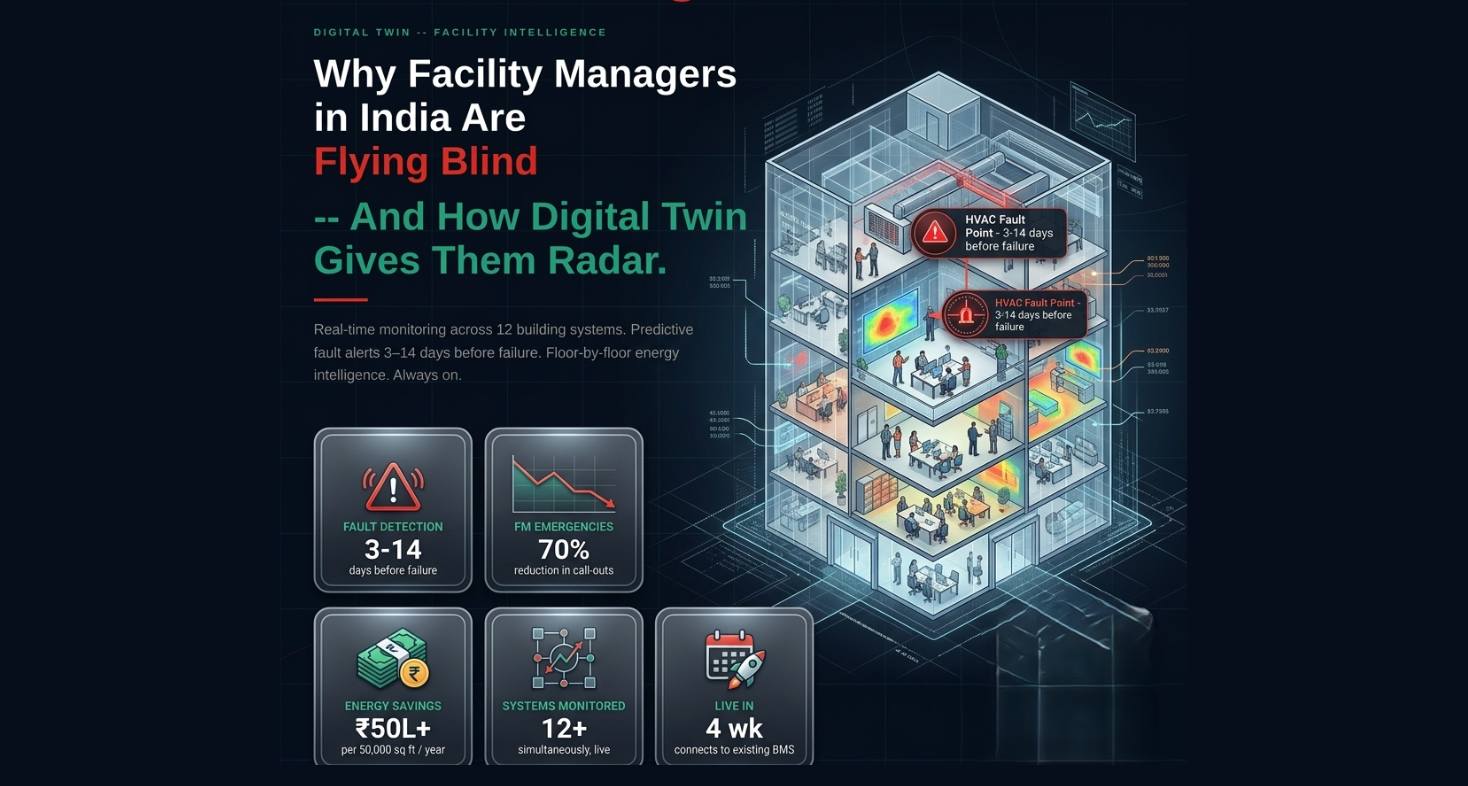
Modern office buildings generate thousands of operational data points every hour. However, many facility teams still rely on complaints and manual inspections to identify problems. As a result, equipment failures, energy overruns, and maintenance delays continue to affect building performance.
This article explains how Digital Twin for Buildings provides real-time intelligence, helping facility managers detect issues early, optimise operations, and make smarter maintenance decisions.
Why Digital Twin for Buildings Matters
Modern Grade A office buildings already collect operational data through Building Management Systems (BMS), energy meters, HVAC controllers, and occupancy sensors. However, data alone does not improve building performance. Organisations also need an intelligent platform that converts this information into actionable insights.
Why Traditional Facility Management Misses Early Warning Signs
Most commercial buildings already generate large volumes of operational data. However, facility teams rarely receive this information in a format that supports fast decision-making. Consequently, many infrastructure problems remain hidden until employees report them.
The problem is not lack of data. It is the absence of a unified intelligence layer that integrates all of these data streams, identifies anomalies automatically, and surfaces actionable alerts to the FM team before faults escalate into failures.
Without that layer, the FM team’s primary source of building intelligence is the employee complaint. An AHU that has been vibrating at an unusual frequency for 13 days becomes visible on Day 13 when someone on Level 4 raises a noise complaint. An electrical circuit showing load imbalance for 6 days becomes visible when it trips during business hours. An energy overrun that has been building across Floor 5 for a quarter becomes visible when the electricity bill arrives.
What the IWPS Digital Twin Does for FM Operations in 2026
1. Continuous Monitoring Across 12 Building Systems
The IWPS Digital Twin connects to your building’s existing data infrastructure — BMS outputs, HVAC controllers, energy meters, occupancy systems — and builds a unified real-time model of your building’s operational state. It monitors simultaneously across HVAC performance by zone, electrical load by circuit, energy consumption versus floor targets, occupancy by floor and zone, BMS system status, plumbing pressure, fire safety system compliance, and lift performance.
The critical distinction from a standard BMS dashboard is the intelligence layer: machine learning algorithms analyse operational patterns and detect anomalies automatically. The system knows what ‘normal’ looks like for each zone, each circuit, and each system — and flags deviations without requiring manual review.
2. Predictive Fault Alerts: Catching MEP Failures 3 to 14 Days Early
Predictive maintenance is one of the biggest advantages of a Digital Twin. Instead of waiting for equipment to fail, the platform continuously analyses operational trends and identifies unusual behaviour several days before breakdowns occur.
Consequently, facility teams schedule maintenance before failures affect building operations.
For FM operations in Indian Grade A offices, this changes the economics of building maintenance entirely. The cost of repairing an AHU bearing failure caught in a predictive alert is typically Rs.40,000 to Rs.80,000 — scheduled during off-hours, no downtime, no complaints. The same failure caught post-breakdown: Rs.2 to 4 lakh in emergency repair, 1 to 3 days of HVAC disruption, and the downstream cost of employee dissatisfaction and potential business interruption.
3. Real-Time Energy Intelligence: Tracking ₹Lakhs in Daily Overruns
Energy management should be continuous rather than monthly. The Digital Twin compares real-time consumption with expected performance and immediately identifies unusual energy usage.
As a result, facility managers reduce energy waste before it appears on the monthly utility bill.
The Digital Twin tracks energy consumption continuously against design targets — by floor, by zone, by system. When a deviation exceeds a defined threshold, it surfaces as an alert, not as a line item on next month’s invoice. For a 75,000 sq ft Chennai office, this real-time energy intelligence typically identifies Rs.25 to 55 lakhs in recoverable annual savings within the first 90 days of monitoring.
4. Live Occupancy Intelligence for FM Decision-Making
FM teams in post-pandemic Indian offices are managing a new challenge: hybrid attendance means occupancy patterns are highly variable and largely invisible. On any given Wednesday, Floor 3 might be at 85% capacity while Floor 6 is at 30%. Without real-time occupancy data, HVAC and lighting run at full capacity across both floors — wasting energy and degrading the occupied-floor experience.
The Digital Twin integrates occupancy data and displays real-time floor utilisation across the building. FM teams use this to adjust HVAC zones dynamically, reduce cleaning frequency on low-utilisation floors, and provide the leadership team with objective utilisation data for lease and fit-out decisions.
Digital Twin vs Traditional Facility Management
| System | Without Digital Twin | With IWPS Digital Twin |
| HVAC | Complaint Day 11. Emergency repair Rs.3.8L. 2-day shutdown. | Anomaly Day 1. Scheduled repair Rs.65K. Off-hours. Zero disruption. |
| Electrical | Circuit trips. Comms room down. Reactive. | Load imbalance Day 6. Rebalanced off-hours. Zero downtime. |
| Energy | 28-35% over budget. Visible on last month’s bill. | Real-time floor tracking. Overruns flagged same day. |
| Occupancy | No data. Full HVAC run across all floors regardless of use. | Live by floor and zone. HVAC adjusted dynamically. |
| BMS | Manual log review weekly. Faults missed between checks. | Continuous automated anomaly detection. Always on. |
Implementing the IWPS Digital Twin
The most common question we receive from FM directors is: do we need to replace our BMS to implement Digital Twin?
The answer is no. The IWPS Digital Twin is designed to connect to your existing building data infrastructure — BMS outputs, energy meters, HVAC controllers — and layer intelligence on top. A typical implementation for a 60,000 to 100,000 sq ft Indian Grade A office runs as follows: data connectivity and baseline model: 1 to 2 weeks. Anomaly pattern calibration: 1 to 2 weeks. Live monitoring and first alerts: operational within 3 to 4 weeks of project start.
Frequently Asked Questions
What is a Digital Twin for Buildings?
A Digital Twin for Buildings is a virtual representation of a physical building that continuously analyses operational data to improve maintenance, energy efficiency, and workplace performance.
How does a Digital Twin improve facility management?
It combines real-time building data with AI to detect anomalies, predict equipment failures, optimise energy use, and support faster maintenance decisions.
Does a Digital Twin replace a Building Management System?
No. A Digital Twin works alongside an existing Building Management System by adding analytics, predictive intelligence, and real-time visualisation.
Which buildings benefit most from a Digital Twin?
Grade A office buildings, Global Capability Centres, commercial campuses, IT parks, hospitals, airports, and large mixed-use developments.
Key Takeaways
- Modern buildings generate valuable operational data.
- Digital Twin converts data into actionable insights.
- Predictive maintenance reduces downtime.
- Real-time energy monitoring lowers operating costs.
- Occupancy analytics improve workplace efficiency.
- Digital Twin supports smarter facility management.
Conclusion
Facility management is no longer just about responding to equipment failures. Modern buildings already generate the data needed to improve operations.
The IWPS Digital Twin transforms that data into real-time building intelligence, helping organisations reduce downtime, optimise energy consumption, improve maintenance planning, and increase workplace reliability.
visit DigitalTwin or DM on LinkedIn. we will send you a capability overview tailored to your building size and existing BMS infrastructure.