
 By Archie J Abraham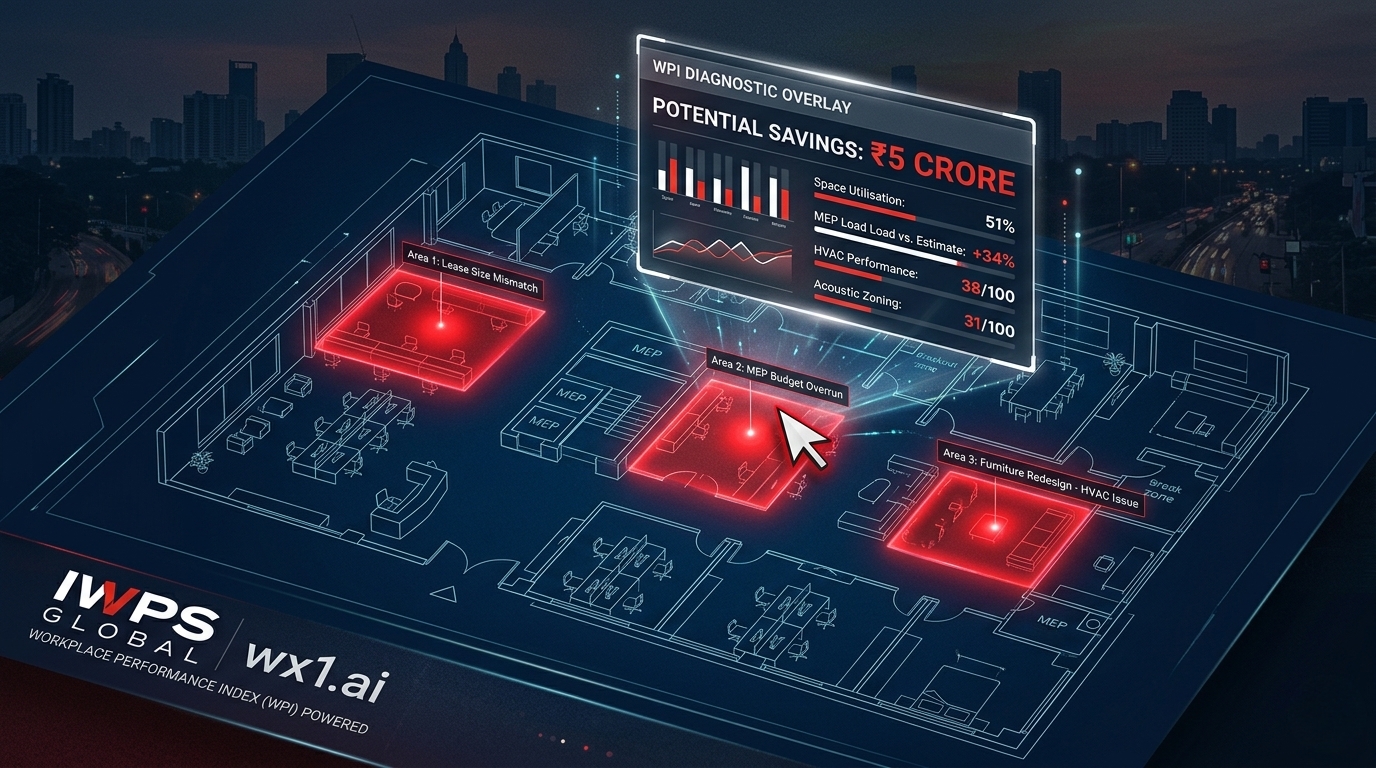
Every office procurement decision has long-term financial consequences. However, many organisations still approve leases, fit-outs, and refurbishments without understanding how their current workplace actually performs. The Workplace Performance Index (WPI) provides data-driven insights before organisations commit their budgets. This article explains three real procurement decisions that cost Indian companies ₹5 crore—and how WPI could have prevented each one.
Decision 1: Oversized Office Lease
A leading financial services company relocating their Mumbai operations signed a 9-year lease on 80,000 sq ft of Grade A office space in Bandra Kurla Complex. The total lease commitment over 9 years exceeded ₹22 Crore.
Six months after the move, facility management data revealed actual occupancy was running at 51%. On any given Tuesday — typically the highest occupancy day in hybrid work environments — 39,000 sq ft of leased space was empty.
The estimated cost of the oversized lease in Year 1 alone: ₹1.8 Crore in rent for unused space.
Why the Lease Was Oversized
The lease decision was based on headcount projections from 2023, before hybrid work patterns had stabilised. No utilisation analysis was conducted on their existing office. No Space Calculator modelling was run to test hybrid scenarios. The team assumed 80% desk utilisation — the actual figure was 51%.
How the Workplace Performance Index Would Have Helped
A pre-decision WPI baseline on their existing space would have immediately flagged a Space Utilisation Efficiency score of 48/100 — indicating severe underutilisation even before the move. The Space Calculator tool would have modelled the hybrid scenarios and recommended a maximum of 55,000–60,000 sq ft. The ₹1.8 Crore Year 1 overspend would have been a procurement constraint, not a post-move surprise.
Decision 2: Incorrect MEP Cost Estimation
A Global Capability Centre in Pune completed a 60,000 sq ft fit-out for 800 employees. The design was award-winning. The project was delivered on schedule. But the MEP estimate — submitted by their interior design firm — was based on industry percentage benchmarks rather than actual load calculations.
When the MEP contractor was appointed, the actual quote came in 34% over the interior designer’s estimate. The project contingency budget was depleted entirely. Additional funds had to be sourced mid-project, causing procurement delays, vendor tension, and a final MEP spend of ₹1.4 Crore over budget.
Why Traditional MEP Estimates Failed
MEP estimation in Indian CRE is structurally broken. Interior designers are not MEP engineers. Percentage-of-project-cost estimates do not account for actual HVAC load requirements, electrical demand profiles, plumbing specifications, or fire safety systems. The gap between a percentage estimate and a data-driven one is consistently 20–40% in Indian Grade A offices.
How WPI Prevented Budget Overruns
IWPS’s MEP Estimator generates a full mechanical and electrical cost estimate in under 3 minutes, based on building type, floor plate, occupancy density, and zoning configuration. For a 60,000 sq ft GCC in Pune, the estimator would have produced a data-driven baseline that matched the actual contractor quote within 8%. The ₹1.4 Crore gap would have been identified in procurement, not discovered after appointment.
Decision 3: Refurbishment Without Workplace Data
A Bangalore technology company undertook a major HQ refurbishment after employee satisfaction surveys showed consistently low scores — particularly around collaboration, wellbeing, and workspace quality. Investment: ₹1.7 Crore in new furniture systems, breakout zones, café-style collaboration areas, and a complete repainting and rebranding of the space.
One year post-refurbishment, the follow-up satisfaction survey showed minimal improvement. Scores moved from 4.9/10 to 5.4/10. Occupancy on Tuesdays through Thursdays remained at 48%. The refurbishment had been a cosmetic intervention on a structural problem.
Why the Refurbishment Failed
The company treated employee satisfaction scores as a design problem. It was not. A proper WPI diagnostic would have revealed: MEP Systems Performance score of 38/100 (indicating significant HVAC underperformance causing temperature and air quality complaints), acoustic performance score of 31/100 (open-plan noise was the primary driver of dissatisfaction), and lighting adequacy at 44/100. New furniture addresses none of these issues.
How WPI Changed the Outcome
A pre-refurbishment WPI diagnostic costs a fraction of the refurbishment itself. It would have directed the ₹1.7 Crore budget toward HVAC recalibration, acoustic zoning solutions, and lighting upgrades — the actual causes of dissatisfaction. Conservative outcome: satisfaction scores above 7.5/10 and occupancy improvement to 68–72%.
Benefits of the Workplace Performance Index
- Measures workplace performance before investment.
- Improves office lease decisions.
- Supports accurate fit-out planning.
- Identifies workplace inefficiencies.
- Helps prioritise refurbishment investments.
- Reduces unnecessary capital expenditure.
- Provides measurable workplace benchmarks.
Why Procurement Teams Need Workplace Performance Data
Most procurement decisions focus on cost.
However, cost alone does not measure workplace performance.
The Workplace Performance Index combines utilisation, employee experience, engineering systems, workplace analytics, and operational performance into one measurable benchmark.
As a result, procurement teams make better investment decisions before budgets are approved.
What These Three Projects Have in Common
Although these projects involved different cities and different workplace challenges, they all shared one problem: decisions were made without workplace performance data.
Consequently, organisations spent crores correcting issues that could have been identified much earlier.
Conclusion
The Workplace Performance Index https://wpi.iwpsglobal.com/ transforms workplace decisions from assumptions into measurable insights.
Instead of relying on industry averages or subjective observations, organisations gain a complete understanding of workplace performance before committing to major investments.
Whether planning a lease renewal, office fit-out, or refurbishment, WPI helps reduce financial risk and improve long-term workplace outcomes.
IWPS Global: https://iwpsglobal.com
IWPS Blog: https://blogs.iwpsglobal.com
Office Space Calculator: https://iip.iwpsglobal.com
MEP Estimator: https://mepest.iwpsglobal.com/
Frequently Asked Questions
What is the Workplace Performance Index (WPI)?
The Workplace Performance Index (WPI) is a workplace assessment framework that measures space utilisation, employee experience, building performance, and operational efficiency before major workplace investments.
Why should organisations measure workplace performance before leasing new office space?
Measuring workplace performance helps organisations understand how existing office space is used. This prevents over-leasing and supports better workplace planning.
How does WPI improve office fit-out projects?
WPI identifies operational, engineering, and workplace performance issues before construction begins. This helps organisations prioritise investments that deliver measurable improvements.
Who should use the Workplace Performance Index?
The Workplace Performance Index is valuable for procurement leaders, facility managers, corporate real estate teams, workplace strategists, and organisations planning office expansions, relocations, or refurbishments.