
 By Archie J Abraham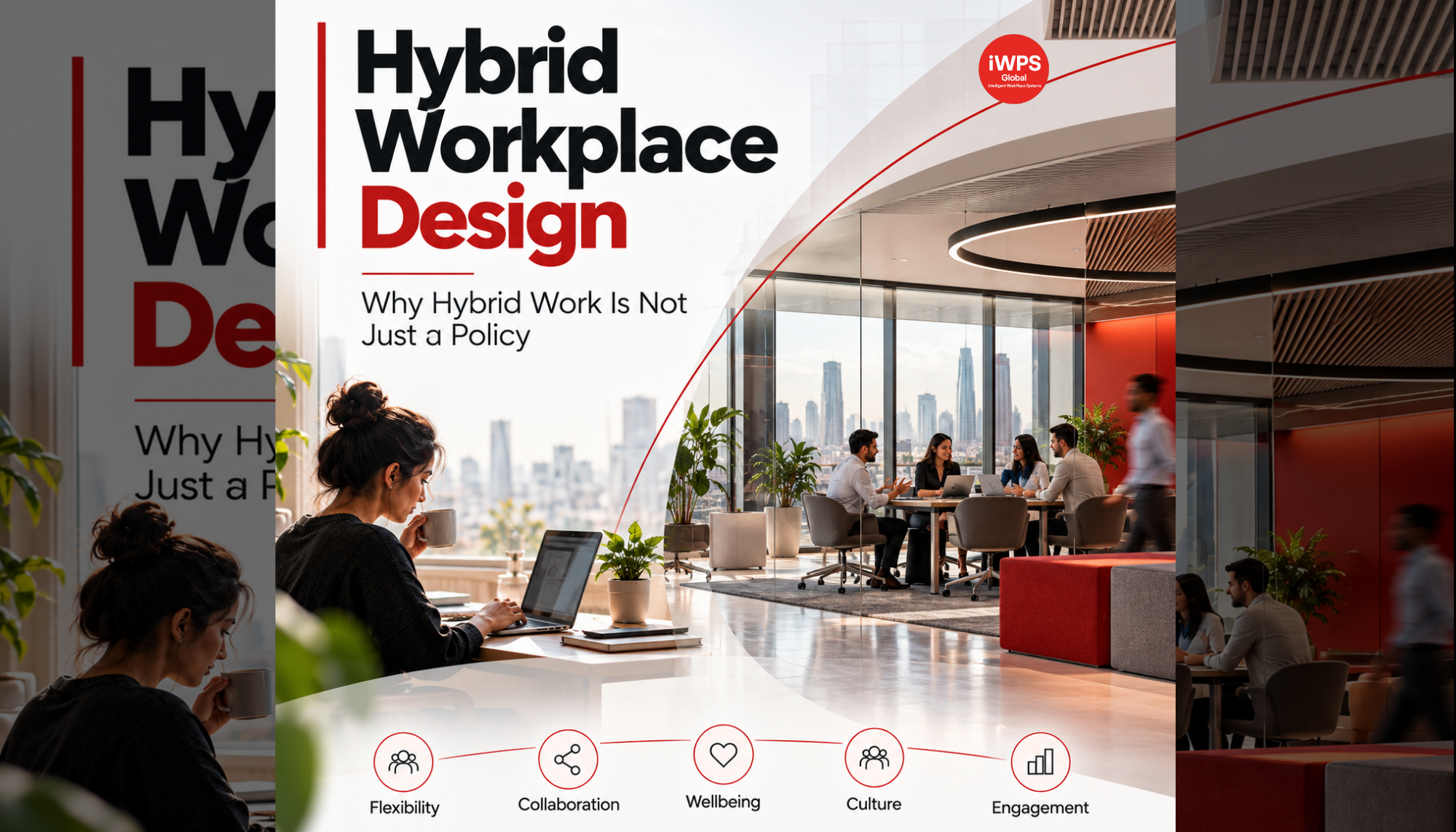
Hybrid work has changed more than where people work.
It has changed how organisations need to think about the workplace itself.
An employee may spend part of the week at home and part of the week in the office. A meeting may involve people sitting around the same table and others joining through a screen. A team may collaborate in person one day and entirely online the next.
That means the workplace is no longer a single physical environment.
It is a combination of physical space, time, technology, culture and work practices.
Yet many organisations still approach hybrid work primarily as a policy question:
How many days should employees come into the office?
A recent systematic review by Roopa Nagori and Natalia Rocha Lawton suggests that the more useful question is broader: How should hybrid work be designed so that employee engagement and wellbeing are supported? Their review synthesised 78 studies and identified five areas that HRD and organisational development practitioners should consider when designing hybrid work.
For workplace leaders, this has an important implication.
Hybrid work cannot be designed only through attendance policies. The workplace itself has to evolve with it.
Why Hybrid Workplace Design Needs More Than a Location Policy
Hybrid work creates flexibility, but flexibility alone does not guarantee a positive employee experience.
The research reviewed by Nagori and Lawton highlights concerns around wellbeing and employee engagement in hybrid environments. It also identifies issues such as professional isolation, work intensification, burnout, technostress and the challenge of maintaining collaboration across physical and digital environments.
At the same time, hybrid work can create opportunities for greater autonomy and flexibility.
The challenge is therefore not simply to decide where employees work.
It is to design the conditions under which they can work effectively across locations.
That includes:
- the physical environment
- working hours and flexibility
- leadership and organisational culture
- job and task design
- collaboration tools
- communication practices
- wellbeing support
The study groups these considerations into five propositions for practice.
1. Design for Both Space and Time Flexibility
The first proposition focuses on providing ongoing support for space and working hours in hybrid work.
This is important because flexibility has two dimensions.
There is where people work.
And there is when they work.
The research highlights the need for suitable, safe and healthy working environments, appropriate ergonomics, access to information and job resources, and flexibility that supports work-life balance. It also stresses that remote and on-site employees should have equitable access to opportunities, resources and collaboration.
For workplace strategy, this changes how office space should be considered.
A hybrid workplace does not necessarily need a desk for every employee.
Instead, it needs the right combination of spaces for the activities people actually perform.
That could include:
- individual focus areas
- collaboration spaces
- meeting rooms
- informal interaction zones
- spaces for virtual meetings
- touchdown areas
- social spaces
- quiet areas
The office becomes less about assigning a permanent seat and more about providing an environment that supports different modes of work.
2. Build Culture and Leadership Into the Hybrid Workplace
Space alone cannot create engagement.
The second proposition focuses on culture and leadership development, particularly around trust and inclusion.
Hybrid working can make some workplace relationships harder to maintain.
When employees interact through digital channels, some of the informal signals that help build relationships can be reduced. Managers may also find it harder to maintain team connections when employees are working across different locations.
The research therefore highlights the importance of open communication, trust, inclusion and leadership development.
This has a physical workplace implication too.
If employees come into the office only to sit individually on video calls, the office may not be supporting the social and collaborative value that brings people together.
The workplace should instead create opportunities for:
Connection → Collaboration → Knowledge sharing → Belonging
This is where workplace design and organisational culture begin to overlap.
3. Design Jobs and Tasks for the Hybrid Environment
The third proposition is about allocating jobs and tasks to suit hybrid work.
Not every task requires the same environment.
Some activities benefit from uninterrupted individual concentration.
Others benefit from face-to-face interaction.
Some require rapid collaboration.
Others can be completed asynchronously.
Treating every activity in the same way can create unnecessary pressure.
A better approach is to understand the relationship between task, place and time.
| Work activity | Potential workplace requirement |
|---|---|
| Focused individual work | Quiet, low-distraction environment |
| Team collaboration | Shared collaborative space |
| Confidential discussion | Enclosed meeting space |
| Virtual meeting | High-quality video/audio environment |
| Informal interaction | Social and shared spaces |
| Creative workshops | Flexible project space |
| Learning and mentoring | Collaborative or dedicated learning space |
The point is not to create a fixed formula for every organisation.
Instead, workplace teams should understand how people actually work before deciding how much space and what types of space they need.
That makes workplace data and employee input valuable parts of the design process.
4. Give People the Right Collaboration Tools — Not More Tools
Hybrid work depends heavily on digital collaboration.
The fourth proposition focuses on providing appropriate collaboration tools while establishing healthy communication practices.
This distinction matters.
More technology does not automatically mean better collaboration.
Too many applications, notifications and digital meetings can contribute to collaboration overload and technostress. The research also highlights the importance of training employees and managers to use technology effectively.
The hybrid workplace therefore needs both:
the right tools
and
the right rules for using them.
For example, organisations can establish clearer expectations around:
- which platform should be used for different activities
- when synchronous meetings are necessary
- when asynchronous communication is more appropriate
- how quickly employees are expected to respond
- when employees should be able to disconnect
- how teams maintain communication across locations
This is also where the physical office matters.
A hybrid meeting room should not simply contain a screen and a conference table.
It should be designed so that remote and in-person participants can participate as equally as possible.
5. Design Flexibility Around Employee Wellbeing
The fifth proposition focuses on individual flexibility and support mechanisms for the wellbeing of hybrid workers.
This is particularly important because flexibility can have different effects on different employees.
For some people, flexibility can improve autonomy and work-life balance.
For others, remote work can increase isolation, blur work and personal boundaries, or contribute to longer working hours.
The research highlights concerns around work intensification, professional isolation, stress and digital wellbeing in hybrid environments.
That means organisations should not treat flexibility as a one-size-fits-all benefit.
Instead, hybrid workplace strategies can consider:
- employee autonomy
- workload
- working hours
- social connection
- manager support
- learning and development
- wellbeing resources
- opportunities for career development
The goal is not simply to give employees more flexibility.
It is to create sustainable flexibility.
The Office Still Matters — But Its Role Is Changing
One of the most important implications for workplace strategy is that hybrid work does not necessarily make the office irrelevant.
It changes what the office needs to do.
If employees can perform individual work from multiple locations, the office can increasingly focus on activities that benefit from physical presence.
That may include:
- collaboration
- team building
- mentoring
- social interaction
- innovation
- learning
- relationship building
- culture
This means workplace planning should begin with a different question.
Instead of asking:
“How many desks do we need?”
organisations can ask:
“What do people need the workplace to help them accomplish?”
That shift can influence everything from space planning to technology infrastructure.
From Desk Planning to Experience Planning
Hybrid work makes traditional space-planning assumptions harder to maintain.
If office attendance varies throughout the week, a workplace can experience periods of high demand and periods of underutilisation.
This creates an opportunity to move from simple desk-counting toward activity-based workplace planning.
For example, organisations can analyse:
Occupancy → Activity → Space Type → Utilisation → Experience
This can help workplace teams understand whether the available environment actually supports the way employees work.
For IWPS Global, this is where workplace analytics and digital workplace tools can support better decisions.
Rather than designing space around assumptions, organisations can use workplace data to understand occupancy patterns, workplace behaviour and changing space requirements.
The objective is not to maximise or minimise office space.
It is to create a workplace that is aligned with how people actually work.
The Hybrid Workplace Needs a Connected Strategy
The five propositions identified by Nagori and Lawton should not be treated as five independent initiatives.
They are connected.
A well-designed workplace can fail if leadership does not support hybrid collaboration.
Strong leadership can still struggle if employees lack appropriate technology.
Good technology can become a source of stress if communication rules are unclear.
And flexible working can become unsustainable if workload and wellbeing are ignored.
This creates a more useful model:
Space + Time + Culture + Tasks + Technology + Wellbeing
Together, these elements shape the hybrid employee experience.
What Workplace Leaders Should Ask
Instead of asking only how many days employees should work from the office, workplace leaders can ask:
1. Does our workplace support the activities people actually perform?
2. Do employees have equitable access to resources and opportunities regardless of where they work?
3. Are our collaboration spaces designed for both physical and remote participants?
4. Are our digital tools helping collaboration or creating additional digital workload?
5. Does our workplace support connection, learning and belonging?
6. Are flexibility and wellbeing being designed together?
7. Are workplace decisions based on actual employee and space data?
These questions move hybrid work from a policy discussion toward a workplace strategy discussion.
What This Means for Workplace Design
The research by Nagori and Lawton provides a useful reminder that hybrid work is not only an HR issue.
It has direct implications for workplace design.
The physical workplace needs to support changing patterns of attendance, different work activities and new expectations around collaboration. At the same time, digital infrastructure, management practices and employee wellbeing need to work alongside the physical environment.
The researchers also note an important limitation: their review draws largely from evidence in the United States, United Kingdom and European Union, and they identify the need for research across additional contexts.
That matters when applying the findings.
There is no universal hybrid workplace formula.
The right workplace strategy depends on the organisation, workforce, work patterns, culture, technology and physical environment.
The Future of Hybrid Work Is About Designing the System
Hybrid work is often described as a balance between the office and home.
But the real workplace is more complex.
It is a system connecting:
People.
Space.
Time.
Technology.
Culture.
Work.
Wellbeing.
When these elements are designed separately, employees can experience friction.
When they are considered together, organisations can create a more connected workplace experience.
The research by Nagori and Lawton offers five practical propositions: support space and time flexibility, develop culture and leadership, allocate tasks appropriately, provide effective collaboration tools, and design flexibility and support around employee wellbeing.
For workplace leaders, the bigger lesson is clear:
Hybrid work should not simply determine when people come to the office. It should influence what the office is designed to help people do.
Conclusion: Design the Workplace Around How Work Happens
The hybrid workplace is no longer defined by a desk, a building or a remote-working policy.
It is defined by the relationship between people, activities and environments.
That means successful hybrid workplace design requires more than reducing desk numbers or introducing flexible schedules.
It requires organisations to understand:
- how people work
- where collaboration happens
- what spaces employees need
- how technology connects teams
- how leadership shapes culture
- and how flexibility affects wellbeing
The office still has a role.
But that role is evolving.
The future workplace is not simply a place employees come to. It is an environment designed around the work, connections and experiences that matter.
Visit: https://iwpsglobal.com/ || https://blogs.iwpsglobal.com/
Explore: https://wx1.ai/
Connect with us on LinkedIn
Frequently Asked Questions
What is hybrid workplace design?
Hybrid workplace design is the planning of physical spaces, work practices, technology and flexibility to support employees who work across office and remote environments.
How can hybrid work affect employee engagement?
The research reviewed by Nagori and Lawton identifies both opportunities and challenges around hybrid work, including flexibility, collaboration, organisational support, professional isolation, work intensification and digital wellbeing.
What are the five propositions for better hybrid work?
The study proposes ongoing support for space and working hours, culture and leadership development, appropriate allocation of jobs and tasks, suitable collaboration tools with healthy communication rules, and individual flexibility and wellbeing support.
Does hybrid work mean companies need fewer office desks?
Not automatically. The research does not establish a universal desk-reduction formula. Workplace requirements depend on how employees work, the activities they perform, attendance patterns and the organisation’s needs.
How can workplace design support hybrid collaboration?
Workplaces can provide spaces designed for collaboration, focused work, meetings, informal interaction and hybrid participation. Digital infrastructure and physical space should work together rather than being planned separately.
What is the biggest challenge in hybrid workplace design?
There is no single universal challenge. The research highlights interconnected issues including wellbeing, engagement, flexibility, culture, task allocation, collaboration technology, technostress and professional isolation.
Source
Nagori, R., & Lawton, N. R. The design of hybrid work for improved employee engagement and well-being: perspectives for HRD practice. International Journal of Human Resource Development: Practice, Policy and Research, 8(2), 83–99. DOI: 10.2478/ijhrd-2024-0010. The article is open access and licensed CC BY-NC-ND.
Read the original research article
[…] That distinctive “new office” smell is not necessarily a sign of quality. It can indicate that recently installed materials are still releasing volatile organic compounds, or VOCs, into the indoor environment. […]