
 By Archie J Abraham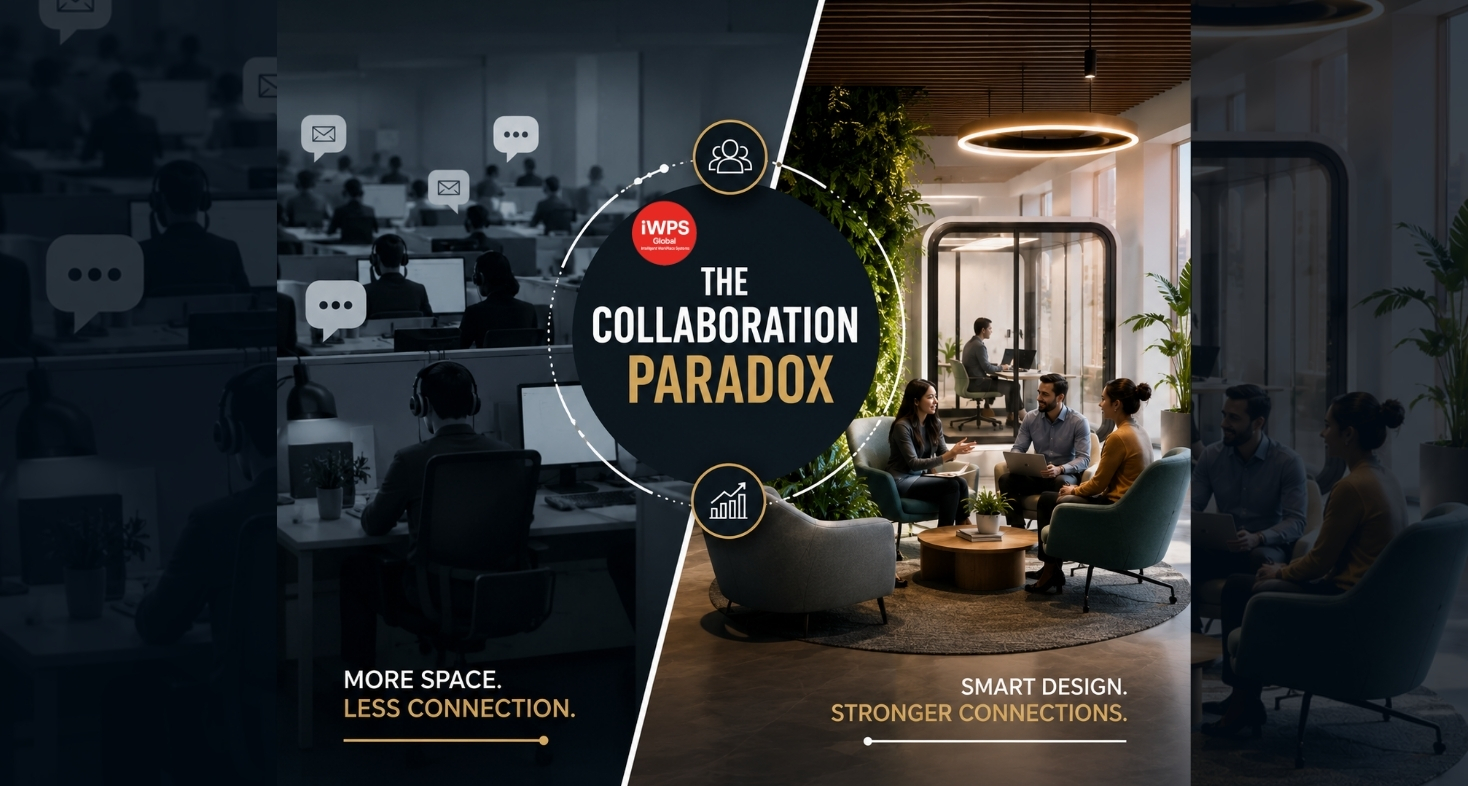
For years, businesses believed that removing office walls would naturally encourage employees to collaborate. Open-plan office design became the default strategy for modern workplaces because it promised better communication, faster decision-making, and stronger teamwork.
However, real workplace data tells a very different story.
Research shows that many open-plan offices reduce face-to-face conversations instead of increasing them. Employees simply replace in-person discussions with emails, instant messages, and headphones. Instead of becoming more collaborative, workplaces often become quieter and less connected.
This is the Collaboration Paradox—the idea that creating more open space does not automatically create more collaboration.
Why Workplace Collaboration Is Declining in Modern Offices
For nearly two decades, organisations invested heavily in open layouts because they appeared to solve several workplace challenges.
Companies believed they could:
- Improve collaboration
- Reduce construction costs
- Create flexible workplaces
- Encourage innovation
- Support flatter organisational structures
These assumptions sounded logical.
Unfortunately, very few organisations actually measured whether these spaces improved workplace performance.
The Research Behind the Collaboration Paradox
One of the most influential workplace studies came from researchers Ethan Bernstein and Stephen Turban.
Instead of relying on employee surveys, they measured actual workplace behaviour using sociometric sensors before and after organisations moved into open-plan offices.
The results surprised the entire workplace industry.
After moving to an open-plan layout:
- Face-to-face conversations dropped by 70%
- Email communication increased by 56%
- Instant messaging increased by 67%
Rather than talking more, employees chose digital communication over direct interaction.
Why Employees Collaborate Less in Open Offices
The problem isn’t collaboration.
The problem is privacy.
When employees lose quiet spaces, they naturally create their own.
They wear headphones.
They message colleagues sitting only a few desks away.
They book meeting rooms for private conversations.
They avoid interruptions instead of encouraging interaction.
In other words, employees replace physical walls with behavioural walls.
The Hidden Cost of Poor Workplace Design
Poor workplace planning affects far more than communication.
It also creates:
- Lower employee productivity
- Meeting room shortages
- Focus booth queues
- Increased digital communication
- Employee frustration
- Underutilised office space
Many organisations believe these are cultural problems.
In reality, they are often workplace design problems.
Three Workplace Design Principles That Improve Collaboration
Successful collaboration depends on workplace design—not simply removing walls.
Research consistently highlights three important principles.
1. Proximity Matters More Than Openness
People collaborate with colleagues who sit nearby.
Simply increasing visibility across an office does not increase interaction.
Teams need thoughtful adjacency, not endless rows of desks.
2. Privacy Encourages Better Collaboration
This sounds counterintuitive.
Yet employees collaborate more confidently when they know quiet spaces are available.
Focus rooms, enclosed meeting spaces, and private booths encourage both concentration and spontaneous discussion.
Privacy actually supports collaboration.
3. Measure Before You Redesign
Every workplace is different.
Instead of copying generic office trends, organisations should measure how employees actually use their space.
Real utilisation data provides better answers than assumptions.
Why Data-Driven Workplace Design Wins
Traditional office design often relies on:
- Industry benchmarks
- Generic layout standards
- Designer experience
- Leadership preferences
Modern workplace strategy relies on evidence.
By analysing workplace analytics, organisations can understand:
- Where collaboration naturally happens
- Which meeting rooms are overused
- Which desks remain empty
- How employees move through the office
- Which zones create the highest productivity
This enables workplace decisions based on measurable performance rather than guesswork.
How the Workplace Performance Score Helps
The Workplace Performance Score (https://wpi.iwpsglobal.com/) replaces assumptions with measurable workplace intelligence.
Instead of asking:
“Do employees like this office?”
WPI answers questions such as:
- Which collaboration zones are most effective?
- Where does focused work actually happen?
- Which spaces remain underutilised?
- How efficiently is office space being used?
- Which design changes will have the greatest business impact?
Rather than relying on opinions, organisations can optimise their workplace using real behavioural data.
The Future of Workplace Collaboration
The future workplace will not be defined by how open it is.
It will be defined by how intelligently it responds to employee behaviour.
High-performing workplaces combine:
- Collaborative spaces
- Focus zones
- Private meeting rooms
- Flexible work areas
- Data-driven workplace analytics
The goal is not to remove every wall.
The goal is to create the right environment for every type of work.
Conclusion
The collaboration paradox proves that open-plan offices alone do not improve teamwork.
Real collaboration depends on thoughtful workplace design, balanced privacy, and measurable workplace performance.
Organisations that use workplace analytics and data-driven planning can create offices that improve collaboration, productivity, and employee experience—while making better use of every square foot.
As workplaces continue to evolve, successful office design will be guided by evidence, not assumptions. The smartest workplaces are those that measure how people actually work before deciding how spaces should be designed.
Great collaboration doesn’t happen by chance—it happens through intelligent workplace design backed by real data.
Discover how IWPS Global helps organisations create workplaces that improve collaboration, employee experience, and space utilisation using AI-powered workplace solutions.
Visit: https://iwpsglobal.com/ || https://blogs.iwpsglobal.com/
Explore: https://wx1.ai/
Connect with us on LinkedIn
Frequently Asked Questions
What is the Collaboration Paradox?
The Collaboration Paradox describes how open-plan offices often reduce face-to-face conversations instead of increasing collaboration.
Why do employees communicate less in open offices?
Many employees seek privacy in open environments. They often use emails, messaging apps, or headphones instead of speaking directly.
How can organisations improve workplace collaboration?
Organisations should combine collaborative spaces, focus areas, and workplace analytics to design offices based on real employee behaviour.
What is the Workplace Performance Score?
The Workplace Performance Score is a data-driven framework that measures workplace performance across space utilisation, employee experience, collaboration, and operational efficiency.
Why is workplace analytics important?
Workplace analytics helps organisations understand how employees use office space, enabling better design decisions, improved collaboration, and higher workplace productivity.