 By Archie J Abraham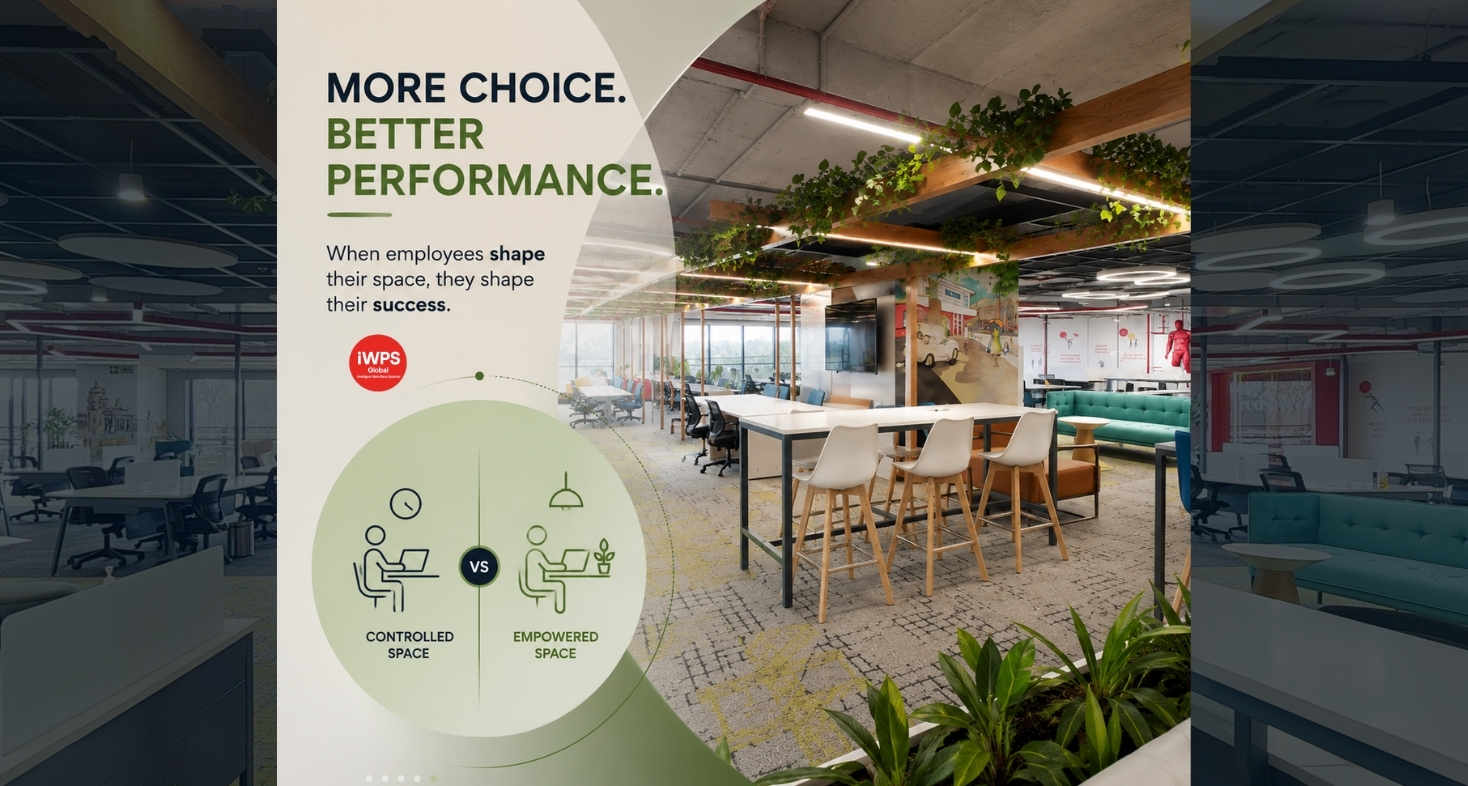
For years, office design focused on efficiency, consistency, and control.
Clean desks. Neutral colours. Standardised workstations. Minimal personal items.
The idea was simple: remove distractions and create a more efficient workplace.
But what if a workplace becomes more productive when employees have some control over the environment around them?
Research highlighted by the University of Exeter challenges the assumption that a highly controlled office is automatically a better one. The findings suggest that workplace design is not only about what is placed in a space. It is also about who gets to influence that space.
That makes employee control in workplace design an increasingly important consideration for organisations planning modern offices.
Why the Traditional “Lean Office” Became Popular
The minimalist office did not appear by accident.
Many workplace practices were influenced by ideas from lean manufacturing, where reducing waste, standardising processes, and controlling variation can improve efficiency.
Those principles work well in environments such as production lines.
However, knowledge work is different.
Employees spend their time solving problems, creating ideas, collaborating, analysing information, and adapting to changing tasks.
In that environment, variation is not always waste.
Sometimes, variation is what makes the work possible.
The newsletter explores this contrast through the idea of the “lean office” — a workplace designed around minimalism and control rather than personalisation and employee ownership.
What the Workplace Study Revealed
Researchers Knight and Haslam compared four different office environments:
- Lean office – a basic, minimally decorated environment.
- Enriched office – a space with plants and artwork.
- Empowered office – employees could arrange elements of the space themselves.
- Disempowered office – employees arranged the space, but their changes were later reversed.
The results were particularly interesting.
The enriched office recorded approximately 17% higher productivity than the lean office.
Even more significantly, the empowered office recorded approximately 32% higher productivity.
The difference raises an important question:
Was productivity influenced by the physical environment alone, or by the sense of ownership employees had over it?
The research suggests that ownership matters.
Employee Control in Workplace Design Can Change the Experience
A workplace is not simply a collection of desks, chairs, walls, and meeting rooms.
People develop a relationship with the environments they use every day.
When employees have reasonable control over their surroundings, they can adapt the space to better suit their work.
For example, teams may adjust:
- Desk arrangements
- Collaborative areas
- Personal workspace elements
- Furniture placement
- Visual elements
- Team zones
This does not mean employees should be allowed to change everything.
Instead, organisations can create structured flexibility.
The space has clear standards, but employees still have meaningful opportunities to influence how it works for them.
Why Personalisation Can Matter at Work
Personalisation is often treated as a visual or aesthetic decision.
However, it can have a deeper role in workplace experience.
A completely standardised workspace communicates:
“This space is assigned to you.”
A workplace that allows meaningful personalisation can communicate:
“This space can work with you.”
That difference can influence how employees perceive the environment.
The University of Exeter research highlighted in the newsletter found that the empowered office performed particularly well because employees had a role in shaping their surroundings.
So, the benefit was not simply about adding plants or artwork.
It was about giving people a sense of authorship.
The Difference Between Enriched and Empowered Workplaces
This distinction is especially useful for workplace designers.
Enriched Workplace
An enriched office improves the physical environment through elements such as:
- Plants
- Artwork
- Better visual appeal
- More engaging surroundings
These additions can make the office more comfortable and stimulating.
Empowered Workplace
An empowered office goes one step further.
Employees are given a degree of control over how the environment is arranged or experienced.
That creates a stronger connection between people and place.
The newsletter summarises this distinction with a powerful insight: the plants helped, but giving employees permission to shape their environment helped even more.
Why Giving Employees Control Does Not Mean Losing Control
This is where workplace strategy becomes important.
Employee control should not mean an office without standards.
Organisations still need to maintain:
- Safety requirements
- Accessibility
- Ergonomics
- Technology standards
- Acoustic performance
- Space efficiency
- Brand consistency
The better approach is to define where flexibility is possible.
For example, an organisation could establish standard workplace guidelines while allowing teams to customise selected zones within those guidelines.
This creates a balance between consistency and autonomy.
Designing for Ownership Instead of Obedience
Traditional workplace planning often asks:
How can we make employees use the office efficiently?
A more progressive question is:
How can we help employees feel that the office works for them?
That shift changes the design process.
Instead of focusing only on:
- Desk density
- Floor area
- Standard furniture
- Visual uniformity
workplace teams can also consider:
- Employee preferences
- Team identity
- Workspace flexibility
- Personalisation
- User control
- Actual space utilisation
The result is a workplace that is designed not just for people, but with people in mind.
How Workplace Data Can Support Better Design Decisions
Employee control is only one part of workplace performance.
Organisations also need to understand whether their spaces are actually being used effectively.
Workplace analytics can help answer questions such as:
- Which areas are used most frequently?
- Where do employees naturally collaborate?
- Which spaces remain underused?
- How does utilisation change throughout the day?
- Which workplace zones support different types of work?
This creates an important connection between employee experience and workplace data.
Rather than assuming what employees need, organisations can measure how people actually use their environment.
What This Means for the Future of Office Design
The future workplace does not necessarily need to become more minimalist, more open, or more automated.
Instead, it needs to become more responsive.
A high-performing workplace could combine:
- Flexible work areas
- Collaborative zones
- Quiet spaces
- Personalised team areas
- Biophilic elements
- Ergonomic furniture
- Data-driven workplace planning
The objective is not to give employees unlimited freedom.
It is to provide the right amount of choice.
The Bigger Lesson: People Perform Differently in Spaces They Can Own
The most valuable takeaway from the research is not simply that plants improve offices.
It is that ownership can influence workplace experience.
The study found that the empowered office achieved approximately 32% higher productivity than the lean office, while the enriched office achieved approximately 17% higher productivity.
That suggests an important principle for modern workplace design:
A workplace should not only tell people how to work. It should give them some ability to shape how they work.
For organisations redesigning offices in a hybrid and increasingly people-centric era, that could be a powerful design principle.
Final Thoughts
Employee control in workplace design is not about abandoning workplace standards.
It is about recognising that people are more than users of a space. They are participants in creating the environment in which they work.
The next generation of workplaces will therefore need to balance efficiency with autonomy, consistency with personalisation, and design with data.
Because sometimes, the most productive office is not the one where everything is controlled.
It is the one where people have a meaningful say in how the space works for them.
Is your workplace designed only for efficiency—or also for ownership?
At IWPS Global, we combine workplace strategy, design, and workplace intelligence to help organisations understand how their spaces perform and how they can work better for their people.
Explore intelligent workplace solutions → https://iwpsglobal.com/ | https://blogs.iwpsglobal.com/