
 By Archie J Abraham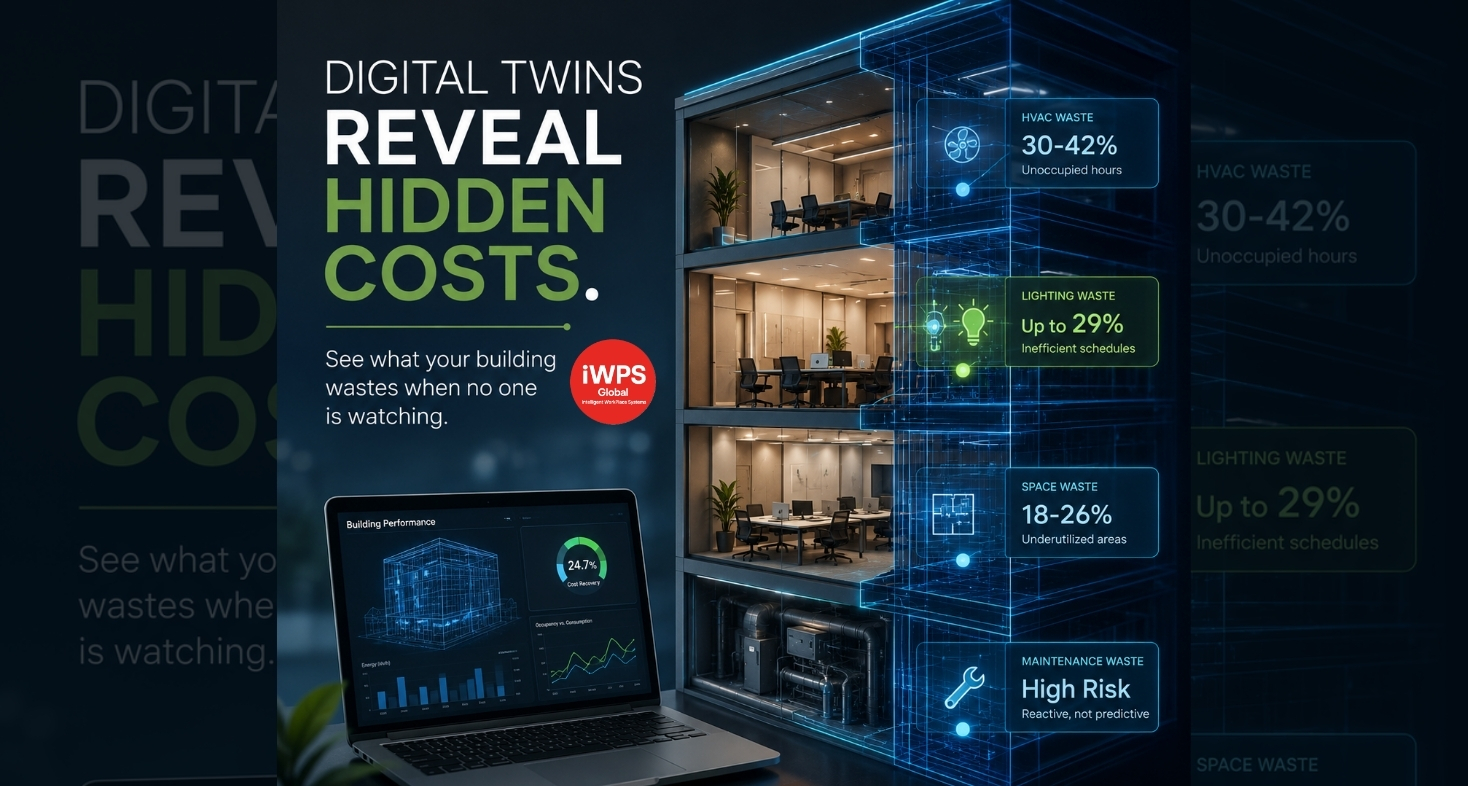
Modern office buildings generate enormous amounts of operational data.
HVAC systems track temperature and runtime. Energy meters record consumption. BMS platforms monitor equipment. Occupancy systems show how people use different floors
Yet, much of this data remains disconnected.
As a result, buildings can continue spending money on spaces, systems, and equipment that are not being used efficiently.
This creates a hidden operating-cost problem.
A Digital Twin for office buildings can help make that waste visible.
What Is a Digital Twin for an Office Building?
A Digital Twin creates a digital representation of a physical building using live operational data.
It can connect information from:
- Building Management Systems
- HVAC equipment
- Energy meters
- Occupancy systems
- IoT sensors
- Building infrastructure
The goal is not simply to display data.
Instead, the Digital Twin helps teams understand how the building is performing and where operational inefficiencies are developing.
Where Do Office Buildings Lose Operating Money?
Hidden costs usually do not come from one obvious problem.
They often build up across several systems.
1. HVAC Runs When Spaces Are Empty
HVAC is one of the biggest areas of building energy consumption.
Many systems operate according to fixed schedules designed around expected occupancy.
However, actual occupancy can vary significantly.
For example, an office may have:
- High occupancy during core hours
- Low occupancy in the evening
- Empty areas during weekends
- Different utilisation levels across floors
When HVAC settings do not respond to these patterns, buildings can end up conditioning spaces that do not need full cooling.
A Digital Twin can compare occupancy data with BMS performance and operating schedules. This helps identify gaps between expected and actual demand.
2. Lighting Schedules Can Become Inefficient
Lighting is another source of hidden energy consumption.
A building may have daylight-harvesting systems and automated controls. However, these settings can become less effective over time. Changes in furniture, occupancy, daylight conditions, or system calibration can affect performance.
A Digital Twin can continuously compare lighting conditions with live environmental data.
This allows facility teams to identify where lighting schedules or set-points need adjustment.
3. Large Floors May Be Serving Fewer People
Hybrid work has changed office utilisation.
A floor may have been designed around peak headcount. Actual occupancy, however, may remain significantly lower on many working days.
This creates another hidden cost. The building may continue operating HVAC, lighting, cleaning, and other services across the entire floor even when only a portion of it is being used.
A Digital Twin can analyse:
- Occupancy
- Density
- Dwell time
- Floor utilisation
- Zone activity
This creates a clearer picture of how much space the organisation actually needs to operate.
Why Traditional Building Data Is Not Enough
Most buildings already collect large amounts of information.
The challenge is making that information useful.
A facility manager may have access to:
- BMS dashboards
- Energy reports
- Maintenance records
- Occupancy reports
- Equipment data
However, these systems often operate separately.
The result is fragmented information.
A Digital Twin brings these signals together. It can then help teams identify relationships between occupancy, energy consumption, equipment performance, and operating schedules.
That creates a more complete view of building performance.
Four Areas Where Digital Twin Technology Can Reduce Waste
The biggest opportunities often come from several improvements working together.
HVAC Optimisation
Adjust operating schedules based on actual occupancy and building demand.
Daylight Re-Harvesting
Improve lighting performance by responding to changing natural-light conditions.
Zone Consolidation
Identify underused areas and avoid operating entire floors when only selected zones are active.
Predictive Maintenance
Use operational patterns to identify potential equipment problems before they become expensive failures.
The newsletter’s year-one savings analysis identifies these four areas as key contributors, with HVAC re-scheduling, daylight re-harvesting, zone consolidation, and predictive maintenance contributing to an overall reported recovery of approximately 24.7% of the MEP baseline across 11 referenced estates.
From Reactive Management to Predictive Operations
Traditional facility management often works retrospectively.
For example: Energy bill arrives → team reviews consumption → problem is identified → corrective action begins.
A Digital Twin can change this workflow.
Instead: Live data → anomaly identified → operational adjustment → measurable savings.
This is an important shift.
Facility teams no longer have to wait for a monthly bill or an occupant complaint to discover that something is wrong.
They can use live building signals to identify potential problems earlier.
The Real Value of a Digital Twin
A Digital Twin is valuable because it connects operational data with decisions.
It can help answer questions such as:
- Are we cooling empty areas?
- Which floors are underutilised?
- Where is energy consumption above target?
- Are lighting systems following the right schedules?
- Which equipment shows unusual behaviour?
- Where can operating zones be consolidated?
- How much cost could be recovered?
These questions move building management beyond simply monitoring what happened.
They create an opportunity to understand what is happening and what should happen next.
What Does the Data Say?
The newsletter highlights a reported 30–42% average MEP waste associated with HVAC and lighting spend during unoccupied hours. It also cites 18–26% typical year-one operating savings as a recoverable range from the referenced Digital Twin deployments.
The important takeaway is not that every building will achieve the same result.
Building size, occupancy, infrastructure, operating schedules, and system configuration all influence the outcome.
Instead, the data points to a broader opportunity:
Buildings can contain significant operational inefficiencies that remain invisible without continuous analysis.
Digital Twin Technology Is More Than a 3D Model
There is a common misconception that a Digital Twin is simply a virtual version of a building.
That misses its real value.
A useful Digital Twin connects the physical building with its operational data.
It can create an intelligence layer across: People + Space + Energy + Infrastructure + Building Systems
This allows facility and real estate teams to move from isolated data points toward a connected view of building performance.
How Indian Offices Can Get Started
Organisations do not necessarily need to rebuild their entire technology infrastructure to start exploring building intelligence.
A practical approach is to begin with the data already available.
Step 1: Establish the baseline
Understand current energy, occupancy, HVAC, and operational performance.
Step 2: Identify the biggest inefficiencies
Look for unnecessary conditioning, lighting waste, underused zones, and recurring maintenance issues.
Step 3: Connect building data
Bring relevant BMS, sensor, energy, and occupancy data into a unified intelligence layer.
Step 4: Measure the impact
Track changes in energy consumption, operating costs, equipment performance, and space utilisation.
This creates a measurable path from building data to business outcomes.
The Future of Office Building Management
The future of facility management will not be defined by how much data a building generates.
It will be defined by how intelligently that data is used.
Digital Twin technology can help organisations uncover hidden operating costs, improve building efficiency, and make better decisions about space and infrastructure.
The biggest opportunity may already exist inside the building.
The challenge is learning how to see it.
See What Your Building Is Really Using
The first step is not replacing your building systems.
It is understanding what those systems are already telling you.
IWPS Global uses Digital Twin technology to connect workplace, infrastructure, occupancy, and building-performance data into actionable intelligence.
Explore how a Digital Twin can help uncover hidden operating costs in your workplace.
Visit: https://iwpsglobal.com/
Explore: https://twindigital.iwpsglobal.com/ || LinkedIn
Frequently Asked Questions
What is a Digital Twin for an office building?
A Digital Twin is a digital representation of a physical building that uses operational data from systems such as BMS, HVAC, energy meters, occupancy systems, and sensors.
How does a Digital Twin reduce building operating costs?
It can identify inefficiencies such as unnecessary HVAC operation, inefficient lighting schedules, underused zones, and potential maintenance issues.
Can a Digital Twin improve HVAC efficiency?
Yes. By comparing occupancy and operational data, a Digital Twin can help identify opportunities to align HVAC operation with actual building demand