
 By Archie J Abraham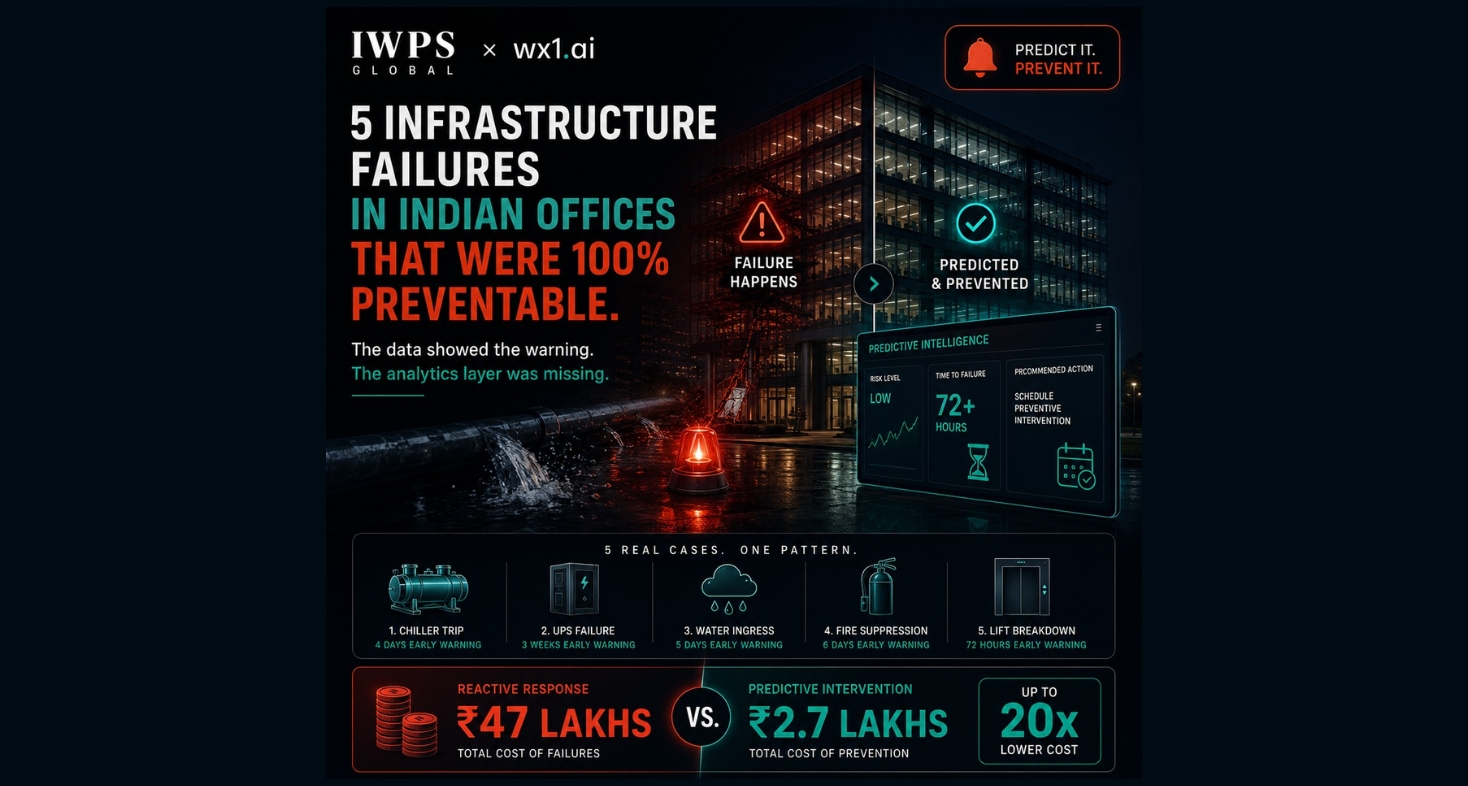
Infrastructure failures rarely happen without warning. Most building systems generate early signals days before equipment fails. However, many organisations rely on reactive maintenance instead of analysing those warning signs.
This article explains five real infrastructure failures in Indian Grade A offices. It also shows how predictive building maintenance and intelligent monitoring could have prevented each incident while saving lakhs in repair costs and business disruption.
Why Predictive Building Maintenance Matters
Many organisations invest in Building Management Systems (BMS), IoT sensors, and maintenance teams. However, collecting data alone does not prevent failures. Organisations also need analytics that identify abnormal equipment behaviour before systems fail.
Predictive building maintenance combines sensor data, equipment history, and operational trends to identify early warning signals. As a result, facility teams can schedule maintenance before equipment breaks down.
Failure 1: The Chiller Trip — Lower Parel, Mumbai, June 2024
A financial services GCC in Lower Parel was in the middle of a Wednesday afternoon when the primary chiller tripped. Three hundred and twenty people were on the floor. By 3:30 PM — ninety minutes after the trip — the floor temperature had reached 32°C. The building management team initiated emergency protocols: portable cooling units were brought in for the server room and critical areas, and an emergency HVAC contractor was called out. The floor returned to normal temperature eighteen hours later.
The building’s BAS recorded the warning signals that predicted this failure for four days. Compressor amperage had been running 18% above normal operating range — a consistent upward drift, not a spike. Condenser approach temperature had risen 3°C above the seasonal baseline over the same period. Refrigerant suction pressure had dropped below the design threshold on two consecutive daily readings.
Each of these signals, individually, sits within the range of normal variation. Together, as a pattern across four days, they constitute a textbook chiller pre-failure signature. A predictive monitoring system reading all three signals simultaneously would have flagged the anomaly on the Sunday before the Wednesday failure — giving the FM team four days to schedule a preventive maintenance intervention.
Cost of failure: ₹11 lakhs | Cost of preventive intervention: ₹55,000 | Ratio: 20×
Failure 2: The Silent UPS Failure — Whitefield, Bangalore, October 2024
A technology GCC in Whitefield had a UPS system installed in 2021 — four years into a five-year battery replacement schedule. The system had passed its most recent scheduled service six weeks before the failure. When a power fluctuation event hit the building at 2:15 PM, the UPS was unable to hold the load. The operations floor went offline. The outage lasted six hours.
The battery degradation that caused this failure had been detectable for at least three weeks before the event. Charge-discharge cycle times had shortened 34% from the new-state baseline — a clear indicator of capacity loss. Internal resistance readings across three of the eight battery strings had moved outside the normal operating range in consecutive monthly checks. Load test performance had been declining across three successive monthly tests, each one showing a lower capacity retention percentage than the last.
The scheduled replacement date of year five was a manufacturer recommendation based on average battery lifespan under standard load conditions. This battery set was operating in an Indian data centre environment with higher ambient temperatures and more frequent power quality events than the standard assumption. It had degraded faster than the schedule anticipated — and the monitoring data showed it.
Cost of failure: ₹9.4 lakhs | Cost of preventive battery replacement: ₹2.1 lakhs | Ratio: 4.5×
Failure 3: Water Ingress to Server Room — Bandra Kurla Complex, Mumbai, July 2024
An overnight monsoon event in July 2024 produced a water ingress incident at a financial services GCC in Bandra Kurla Complex. A roof expansion joint that had been flagged for inspection during the pre-monsoon building review — but had not been inspected — failed under sustained rainfall. Water tracked along a structural beam and reached the ceiling cavity above the server room. By the time the building management team was notified at 6:20 AM, water had entered two server racks. The remediation process, equipment assessment, and data recovery took three weeks.
The precursor signals were present five days before the failure. Roof drain flow sensors at the affected drainage zone were showing reduced flow rates — consistent with partial blockage that reduces drainage capacity before a sustained rainfall event. The expansion joint inspection was six weeks overdue against the compliance schedule, a gap that was visible in the maintenance log. A pressure anomaly in the drainage pipework above the server room ceiling void had been recorded by the BAS two days before the event.
This failure is particularly preventable because the monsoon is not an unexpected event in Mumbai. The annual monsoon season creates a predictable window of elevated water ingress risk that should trigger specific pre-season monitoring protocols — roof drain capacity checks, expansion joint inspection, and drainage system pressure testing — in every Grade A Mumbai building.
Cost of failure: ₹18.5 lakhs | Cost of preventive inspection and drainage clearance: ₹38,000 | Ratio: 49×
Failure 4: Repeated Fire Suppression False Alarms — Hyderabad, March 2025
A GCC in Hyderabad experienced three full building evacuations in thirty days — all triggered by false alarms from the fire suppression system. The third evacuation occurred during a client presentation. The operational and reputational impact was significant. The fire safety contractor was called in after the third event and identified sensitivity drift across fourteen smoke detectors in one zone, combined with dust contamination in the detector housings.
The detector sensitivity drift that caused the false alarms had been accumulating over months. The building’s fire system monitoring was recording self-test results for every detector on a daily basis. The failure rate on self-tests in the affected zone had been rising over a six-week period before the first false alarm. Several detectors in that zone had not been recalibrated in twenty-two months — four months beyond the manufacturer’s twelve-month recalibration recommendation — a gap that was visible in the compliance log.
False alarm pattern analysis is one of the most underused capabilities in Indian building management. A system that tracks self-test failure rates and recalibration intervals by zone can identify detector degradation weeks before it produces a false alarm — let alone the kind of repeated false alarm pattern that this building experienced.
Cost of failure: ₹4.2 lakhs | Cost of preventive recalibration: ₹28,000 | Ratio: 15×
Failure 5: Lift Entrapment — Electronic City, Bangalore, February 2025
Eight people were trapped in a lift between floors in a GCC office tower in Electronic City for forty-seven minutes. The lift had been serviced five weeks before the entrapment and had been cleared with no faults recorded. Engineers traced the failure to a motor control fault— classified as an unexpected component failure in the post-incident report.
The building’s lift monitoring system had been recording anomalous signals for two weeks before the entrapment. Motor current draw had been rising 12% above the post-service baseline — a consistent upward trend, not a one-off reading. Door dwell time had been extending on every third cycle, indicating alignment drift in the door mechanism. The lift’s control system error log had recorded six non-critical faults in ten days — each individually below the threshold that triggers a maintenance alert, but collectively forming a pattern that should have flagged a service review.
The regulatory dimension of this failure is significant. In India, a lift entrapment event triggers mandatory reporting to the state Directorate of Factories and Boilers and can result in a mandatory shutdown order pending inspection. The post-entrapment regulatory process added three weeks and ₹1.2 lakhs in regulatory compliance costs to the total failure cost.
Cost of failure: ₹3.8 lakhs | Cost of preventive motor inspection: ₹18,000 | Ratio: 21×
What These Five Failures Have in Common
These five cases span five different infrastructure categories, five different Indian cities, and a twelve-month period. They involve different building types, different FM teams, and different building management systems. What they have in common is specific, identifiable, and instructive.
In every case, the failure was preceded by a detectable anomaly in the building’s performance data. In every case, the building’s monitoring system was recording that anomaly. In every case, the anomaly was not being read as a failure warning — either because the monitoring system did not have an analytical layer that could identify the signal as a precursor pattern, or because the signal was below the single-threshold alert level while the multi-signal pattern above threshold was not being tracked.
The total cost of the five failures: ₹47 lakhs. The total cost of preventive interventions that the precursor data would have triggered: ₹2.7 lakhs. The ratio: 17.4 times. This is not an unusual ratio for Indian Grade A buildings operating on reactive maintenance. It is the consistent economics of the reactive vs. predictive maintenance gap.
The IWPS IIP Monitoring Layer
The IWPS Intelligent Infrastructure Platform is the analytical layer that reads existing building data as predictive failure signals. It ingests BAS data, power monitoring feeds, sensor data, and maintenance records, and applies anomaly detection against calibrated normal operating envelopes for each monitored system. When the IIP identifies a multi-signal pattern consistent with impending failure — like the chiller pre-failure signature or the UPS battery degradation profile — it generates an FM-actionable alert 72 to 120 hours before the predicted failure event.
The IIP would have flagged each of the five failures described in this article in advance. For four of the five, the lead time would have been sufficient for a scheduled preventive intervention during a non-business-hours maintenance window — eliminating the operational impact entirely. For the monsoon water ingress case, the IIP alert would have triggered a drainage inspection and expansion joint check during the pre-monsoon preparation period that should have already been in the maintenance schedule.
Learn how IWPS Intelligent Infrastructure Platform (IIP) helps facility teams monitor building performance
Explore more Workplace Intelligence Articles https://blogs.iwpsglobal.com/
Infrastructure failures are rarely unexpected. Most building systems generate warning signals long before equipment stops working. The challenge is recognising those signals early enough to act.
The IWPS Intelligent Infrastructure Platform transforms existing building data into predictive maintenance insights. Instead of reacting to failures, organisations can identify risks early, schedule maintenance proactively, reduce operational costs, and improve business continuity. Visit iWPS Global / wX1.ai or connect us on LinkedIn for more updates.
Frequently Asked Questions: Predictive Building Infrastructure
Why do infrastructure failures occur in Grade A buildings that already have BMS sensors?
Most Indian Grade A buildings have the necessary sensors, but they lack an analytical layer to interpret the data. Standard Building Management Systems (BMS) are often calibrated to flag immediate safety risks or total system failures rather than the gradual performance drift that precedes a breakdown. Consequently, clear warning signals are generated and logged but are rarely acted upon until the system stops working entirely.
What is the financial impact of shifting from reactive to predictive maintenance?
The cost difference is significant, often ranging from 10 to 50 times the cost of a preventive intervention.
- Reactive Cost: Across five studied cases, the total cost for emergency repairs and downtime reached ₹47 Lakhs.
- Predictive Cost: Addressing the same issues based on early warning signals would have cost only ₹2.7 Lakhs.
- The Ratio: This represents a 17.4× return on investment in favor of predictive intelligence.
Does the IIP require new hardware or sensor installation?
No, the IIP is a hardware-agnostic AI layer. It integrates with existing BMS infrastructure, power monitoring feeds, and maintenance records already present in most Grade A offices built after 2018. It turns raw data into actionable financial decisions without the need for extensive site modifications.