
 By Archie J Abraham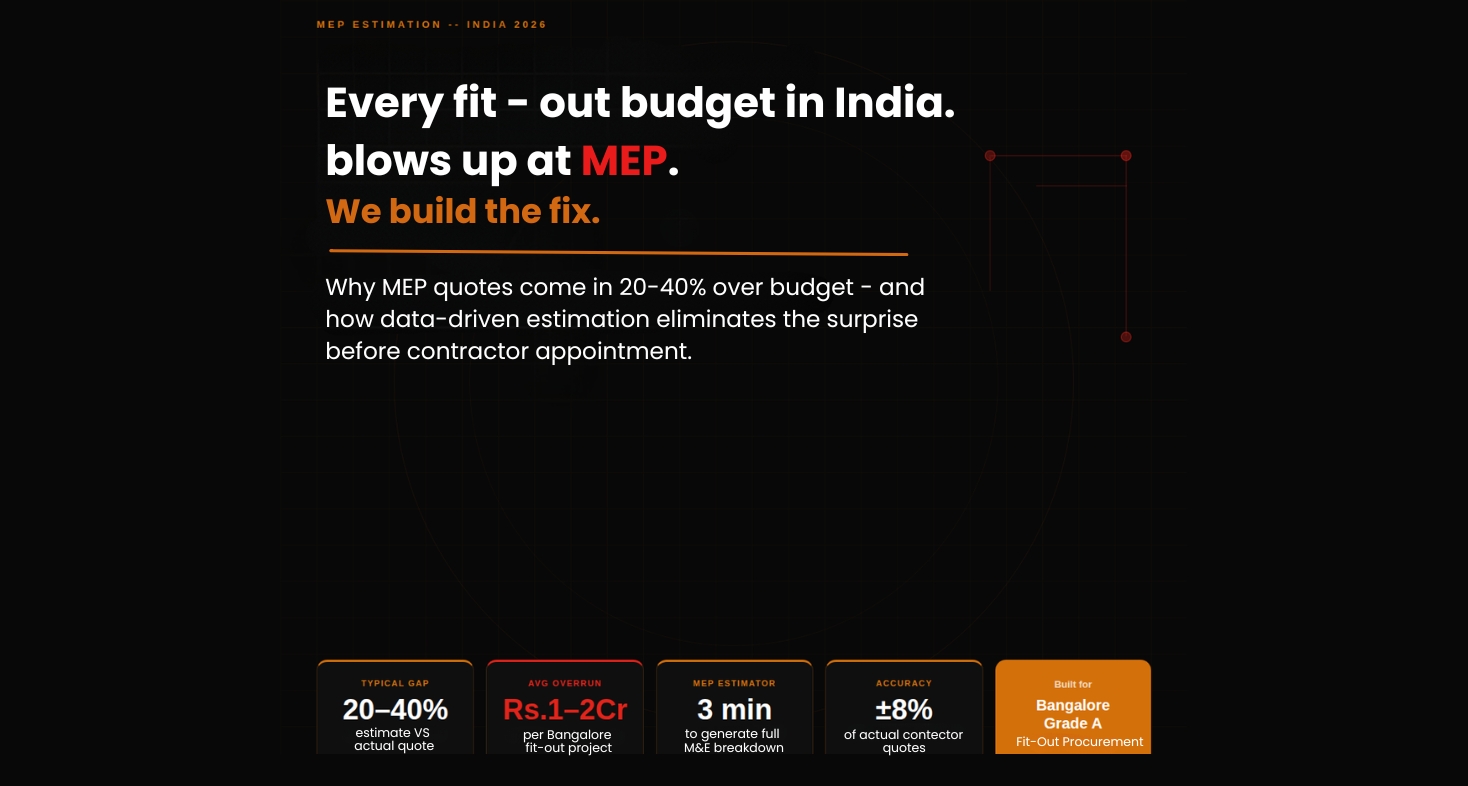
MEP Cost Estimation is one of the biggest challenges in commercial office fit-out projects. Many organisations approve budgets using percentage-based estimates instead of engineering data. As a result, contractor quotations often exceed expectations, forcing procurement teams to increase budgets before construction even begins.
This article explains why traditional MEP estimation fails and how data-driven cost estimation helps organisations improve procurement and reduce project risk.
The Structural Problem: Why Percentage Estimates Always Fail
MEP — mechanical, electrical, and plumbing represents 28 to 40% of total fit-out cost in a Bangalore Grade A office. It is the most technically complex portion of any fit-out project, and it is almost universally estimated using the least sophisticated method available: a percentage of total project cost.
Interior designers, project managers, and even specialist cost consultants apply a benchmark percentage — typically 28 to 35% of total fit-out cost — as a proxy for MEP spend.
This approach is simple, fast, and deeply flawed. Here is why.
HVAC Cost Depends on Thermal Load, Not Project Value
HVAC systems represent the largest component of most MEP budgets. However, cooling requirements depend on thermal load rather than the overall project value. Factors such as occupancy density, glazing, equipment heat, and floor layout determine HVAC capacity. Consequently, two offices with different interior budgets may require the same mechanical infrastructure.
Why GCC Offices Require Higher Electrical Infrastructure Budgets
Technology companies and Global Capability Centres (GCCs) require significantly higher electrical capacity than traditional commercial offices. Server rooms, UPS systems, high-density workstations, and specialised IT infrastructure increase power demand. As a result, standard percentage-based estimates often underestimate electrical costs.
Why Early MEP Cost Estimates Often Fail Before Procurement
The most fundamental problem is timing. Percentage MEP estimates are typically generated at the design concept stage, before any MEP engineering work has been done. When MEP engineering specifications are eventually developed and priced by a real contractor, the gap between the early estimate and the engineering reality becomes visible. By this point, the budget has been approved, the project timeline is committed, and the procurement team has no leverage.
The Financial Impact of Poor MEP Cost Estimation
For a 50,000 square foot Bangalore Grade A fit-out, a 25% MEP underestimate represents Rs.60 lakhs to Rs.1.2 crore of unbudgeted spend. This typically comes out of contingency — and once contingency is depleted, every change order becomes a boardroom conversation. Projects that could have been managed professionally become procurement disputes, timeline delays, and strained vendor relationships.
The Bangalore GCC market compounds this problem. GCC fit-outs tend to involve more complex MEP requirements — higher electrical density, more sophisticated data infrastructure, server room cooling, specialised plumbing for large pantry and wellness areas. Standard commercial MEP benchmarks underestimate these requirements consistently.
How Data-Driven MEP Cost Estimation Improves Budget Accuracy
The solution to this problem is conceptually simple: produce a rigorous, data-driven MEP cost estimate before going to market for contractor quotes, and use that estimate as a procurement benchmark. The complexity has always been in execution — building a reliable estimation model requires deep knowledge of Bangalore MEP contractor pricing, real electrical and mechanical engineering standards, and the ability to model actual project specifications rather than apply generic percentages.
The IWPS MEP Estimator does this. It takes four inputs — floor area, occupancy density, building type, and zoning configuration and generates a full line-by-line MEP cost breakdown across mechanical, electrical, and plumbing in under three minutes. The estimate is calibrated to current Bangalore Grade A MEP contractor pricing and engineering standards, and delivers accuracy within 8% of actual contractor quotes.
The output is not a single number. It is a full breakdown: HVAC system type and tonnage, AHU count and specification, electrical panel sizing, power density by zone, data and communication infrastructure, UPS requirements, lighting design allowance, sanitary plumbing, fire suppression, and specialised drainage. This breakdown gives procurement teams the information to evaluate a contractor quote line by line rather than accepting a total.
How Data-Driven MEP Cost Estimation Changed Procurement Decisions
When a Bangalore procurement team enters contractor appointment with a data-driven MEP benchmark, the dynamic shifts fundamentally. Contractor quotes are evaluated against the benchmark, not accepted as market reality. Variances require explanation. Where a contractor prices above benchmark, the procurement team can ask specifically which line item is driving the difference — and engage in a data-driven negotiation rather than a subjective one.
One procurement team running a 65,000 square foot GCC fit-out in Whitefield used this approach before their MEP contractor RFP. Their data-driven estimate identified a benchmark of Rs.4.1 crore. The first contractor quote came in at Rs.6.4 crore. With a credible benchmark in hand, they were able to interrogate the variance, identify where specifications were gold-plated beyond their requirements, and ultimately appoint a contractor at Rs.4.3 crore — within 5% of their data-driven estimate. Saving: Rs.2.1 crore.
Key Takeaways
- Percentage-based MEP estimates often underestimate project costs.
- Engineering benchmarks improve budget accuracy.
- Data-driven procurement strengthens contractor negotiations.
- Early cost estimation protects contingency budgets.
- The IWPS MEP Estimator produces results in minutes.
- Better cost visibility leads to smarter commercial office investments.
Getting Started with the IWPS MEP Estimator
If you are planning a commercial office fit-out, refurbishment, or GCC expansion, the best time to estimate MEP costs is before issuing the RFP. The IWPS MEP Estimator provides engineering-based cost benchmarks that improve procurement planning, contractor negotiations, and budget accuracy.
Visit https://iwpsglobal.com/ explore the mepest.iwpsglobal.com or connect with us on LinkedIn to request a sample project report.
Frequently Asked Questions About MEP Cost Estimation
What is MEP Cost Estimation?
MEP Cost Estimation calculates the expected cost of mechanical, electrical, and plumbing systems using engineering data instead of percentage-based assumptions.
Why do traditional MEP estimates exceed budgets?
Traditional estimates use generic cost percentages that often ignore project-specific engineering requirements such as HVAC load, electrical density, and occupancy.
How does the IWPS MEP Estimator improve procurement?
The platform generates engineering-based cost benchmarks that help procurement teams compare contractor quotations, identify cost variations, and negotiate with greater confidence.
When should organisations prepare an MEP estimate?
The best time is before issuing the Request for Proposal (RFP) and before finalising engineering designs.
[…] Deep Dive: The Structural Problem with Fit-Out Budgets […]