
 By Archie J Abraham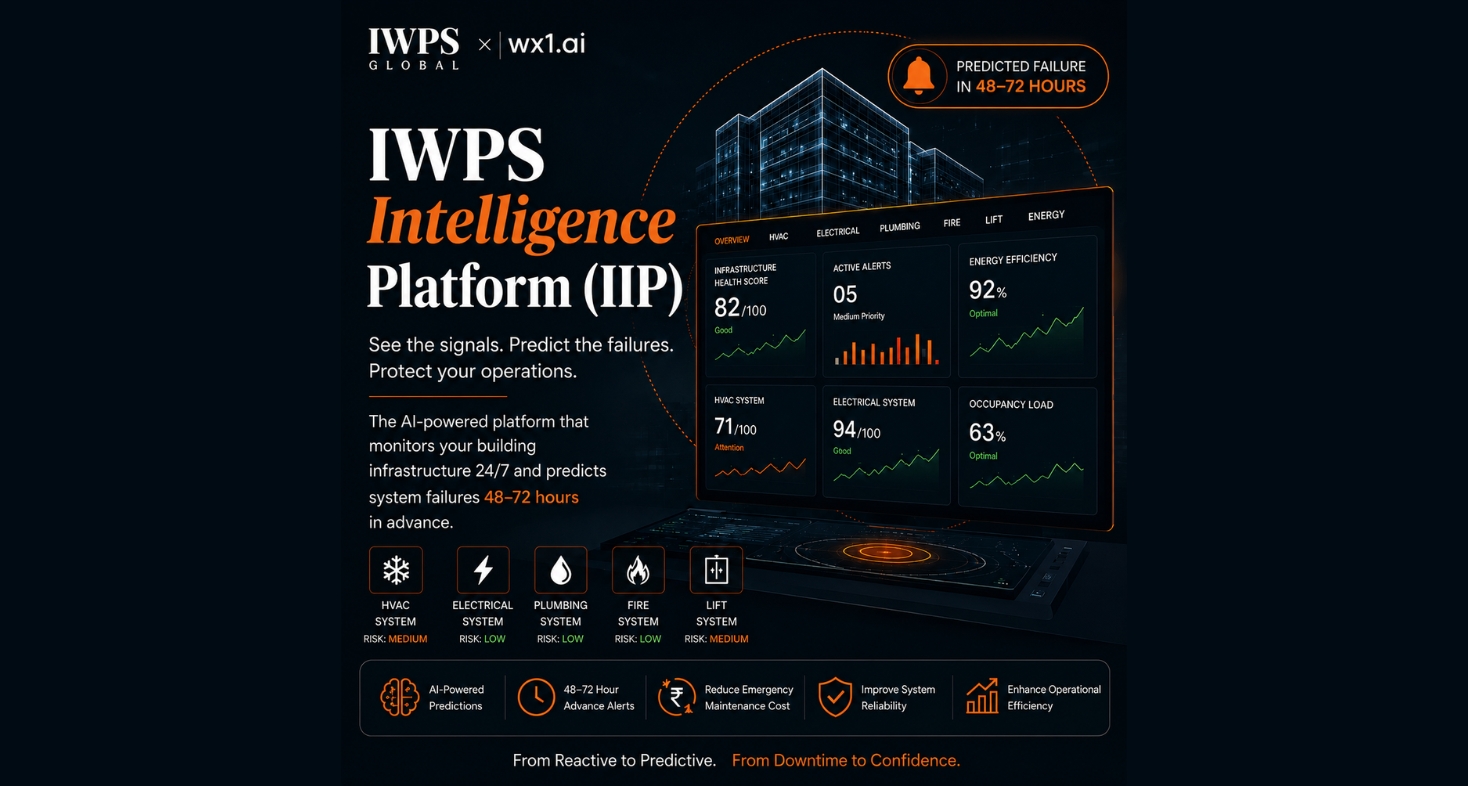
Most infrastructure failures do not happen without warning. Modern office buildings generate thousands of sensor readings every hour, yet many facility teams only act after equipment fails. As a result, emergency repairs, downtime, and unexpected costs continue to affect Indian commercial buildings. This article explains why predictive infrastructure monitoring is becoming essential for smart office buildings and how the Intelligent Infrastructure Platform (IIP) helps detect problems before they disrupt operations.
The explanation is always familiar:
- The system failed suddenly.
- The BMS didn’t raise a critical alert.
- The contractor is on the way.
- The repair may cost ₹10–20 lakhs.
But what rarely gets discussed is this: The building had already generated warning signs. The building had been generating failure signals for days. Nobody was interpreting them. That is the real infrastructure problem in Indian commercial real estate today.
Why Indian Grade A Office Buildings Still Experience Major Infrastructure Failures
Modern Indian office buildings are filled with sensors. Most Grade A offices constructed after 2018 already have:
- Building Management Systems (BMS)
- HVAC sensors
- Electrical monitoring
- Occupancy tracking
- Energy analytics
- Lift and plumbing monitoring
And yet, infrastructure failures continue to happen repeatedly across:
- Bangalore GCC campuses
- Mumbai commercial towers
- Hyderabad IT parks
- Gurgaon Grade A offices
According to operational benchmarks across Indian CRE environments, most Grade A office buildings still experience 4–7 significant infrastructure failures every year.
These include:
- HVAC breakdowns
- Electrical faults
- Lift shutdowns
- Plumbing failures
- Fire suppression alerts
The issue is not lack of technology. The issue is that most buildings still operate reactively.
Why Most Smart Buildings in India Still Operate Reactively
This is where most smart building conversations become misleading. Having a Building Management System does not automatically make a building intelligent. A typical Indian Grade A office generates thousands of infrastructure data points every hour:
- Temperature fluctuations
- Pressure variations
- Power load changes
- Occupancy spikes
- Energy consumption shifts
The data exists. But most FM teams never receive it in a form that helps them act early. There are two reasons for this:
1. Raw BMS Data Is Too Complex
Most facility teams do not have the bandwidth to continuously analyse massive streams of sensor data while also managing daily operations.
2. Traditional Alerts Trigger Too Late
Most BMS alerts are configured to detect confirmed failures — not gradual degradation patterns that appear 48–72 hours earlier.
The result:
- Early warnings get ignored
- Teams become reactive
- Failures escalate into operational disruptions
The signal exists. The intelligence layer does not.
The Real Cost of Reactive Facility Management in India
Emergency infrastructure management is expensive. Not just because of repairs — but because of disruption.
A single HVAC failure in a Bangalore office during summer can cost:
- ₹8–25 lakhs in emergency intervention
- Productivity loss across operations teams
- Employee dissatisfaction
- Escalation to leadership
- Weekend shutdown costs
The same issue, identified early through predictive monitoring, may cost only: ₹1–4 lakhs in planned maintenance. Across a typical 60,000 sq ft Indian office, reactive maintenance can create: ₹30–80 lakhs of avoidable infrastructure cost every year. Over a 5-year lease cycle: ₹1.5–4 Crore in preventable operational spend
This is why predictive infrastructure monitoring is becoming critical for:
- GCC offices in India
- Smart buildings
- Large enterprise campuses
- Facility management teams
- CRE asset owners
What Is Predictive Infrastructure Monitoring?
Predictive infrastructure monitoring uses AI and real-time sensor analysis to identify infrastructure failure patterns before systems break down.
Instead of waiting for a failure:
- The platform identifies performance drift
- Detects anomaly patterns
- Predicts failure probability
- Generates actionable FM alerts
This changes infrastructure management from: Reactive → Predictive
The Intelligent Infrastructure Platform (IIP)
The Intelligent Infrastructure Platform (IIP) is an AI-powered predictive infrastructure monitoring IWPS designed the platform for Indian office buildings.
It connects to existing building infrastructure systems and continuously analyses live operational data to identify early-stage failure patterns.
The platform monitors:
- HVAC systems
- Electrical infrastructure
- Plumbing systems
- Fire suppression systems
- Vertical transportation systems
without requiring major new hardware installation in most modern buildings.
How the IIP Works
The IIP creates a baseline performance profile for every monitored system. It then uses machine learning models trained on Indian office infrastructure patterns to detect:
- Temperature drift
- Load imbalance
- Pressure anomalies
- Energy spikes
- Utilisation irregularities
- Equipment degradation signals
When a pattern matches a known failure precursor:
- The platform sends the FM team a prioritised alert.
- Predicted failure window is identified
- Recommended maintenance action is suggested
- Planned vs emergency repair cost comparison is generated
This transforms infrastructure maintenance into a measurable financial decision.
Example: HVAC Failure Prediction in a Bangalore GCC
In a Bangalore GCC environment:
- Chiller supply temperature drift increased gradually over 48 hours
- AHU strain patterns escalated
- Thermal imbalance spread across one operations floor
The BMS logged the signals. But no predictive intelligence layer interpreted them.
As a result, cooling failed across the operations floor. The organisation required emergency contractor support, weekend repairs, and experienced significant operational disruption. However, predictive monitoring could have identified the warning signs two days earlier and prevented the failure.
With predictive infrastructure monitoring, the FM team could have intervened before failure occurred.
Infrastructure Health Scores: The Future of Facility Management
One of the most important shifts in smart building operations is measurable infrastructure visibility.
The Intelligent Infrastructure Platform (IIP) generates:
- Weekly infrastructure health scores
- System-level performance scores
- Failure risk indicators
- Open alert summaries
Example:
- Overall Building Health Score: 82/100
- HVAC: 71 (Amber)
- Electrical: 94 (Green)
This allows:
- FM teams
- GCC operations leaders
- Asset owners
- Procurement stakeholders
to understand infrastructure risk in real time. Infrastructure management becomes:
- Measurable
- Predictable
- Financially visible
Why Predictive Infrastructure Intelligence Matters for Indian CRE
India’s commercial real estate market is scaling rapidly. GCC expansion, smart buildings, and hybrid workplaces are increasing infrastructure complexity across:
- Bangalore
- Hyderabad
- Mumbai
- Chennai
- Gurgaon
- Pune
But operational infrastructure intelligence has not evolved at the same pace. The buildings already generate the data. The opportunity now is converting that data into:
- Operational foresight
- Predictive maintenance
- Cost reduction
- Workplace reliability
The next generation of Indian smart buildings will not be defined by how many sensors they install. They will be defined by how intelligently they interpret the signals those systems already generate. The competitive advantage is no longer infrastructure visibility. It is infrastructure intelligence.
Getting Started with IIP
The Intelligent Infrastructure Platform (https://iip.iwpsglobal.com/) integrates with existing BMS infrastructure already present in most Indian Grade A office buildings constructed after 2018. No major new hardware deployment is required in most cases.
If you manage:
- Facility operations
- Infrastructure systems
- GCC workplaces
- Smart building assets
If you manage facility operations, infrastructure systems, or GCC workplaces in India. visit the https://iwpsglobal.com/ or Connect us on Linkedin to request a sample infrastructure health report tailored to your building type
FAQ — Predictive Infrastructure Monitoring in India
What is predictive infrastructure monitoring?
Predictive infrastructure monitoring uses AI and live sensor data to detect infrastructure degradation patterns before failures occur in office buildings.
Can BMS systems predict failures automatically?
Most traditional BMS systems detect confirmed failures or threshold breaches, but they do not analyse long-term degradation patterns using AI.
How much can predictive maintenance reduce operational costs?
For Indian Grade A office buildings, predictive maintenance can reduce infrastructure-related emergency costs by 3–5x compared to reactive maintenance models.
Does the IIP require new hardware installation?
In most modern Indian office buildings constructed after 2018, the IIP integrates directly with existing BMS infrastructure and sensor systems.
[…] A buildings operating on reactive maintenance. It is the consistent economics of the reactive vs. predictive maintenance […]