
 By Archie J Abraham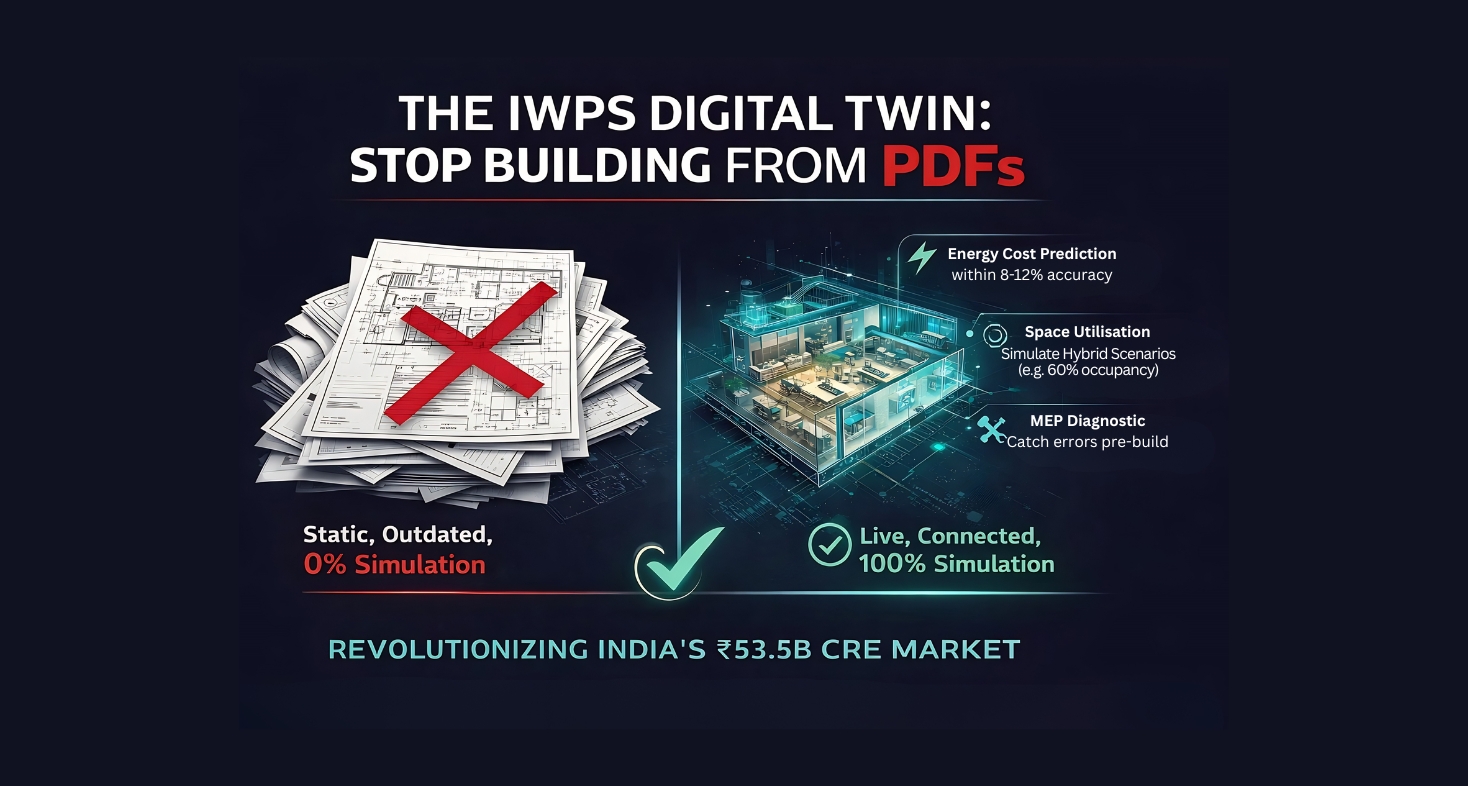
Modern office buildings generate enormous amounts of operational data. However, many organisations still design, construct, and manage offices using static floor plans and assumptions instead of real performance data.
The IWPS Office Building Digital Twin creates a live digital replica of an office building, enabling organisations to simulate layouts, predict energy performance, optimise workplace design, and monitor building operations in real time.
What Is an Office Building Digital Twin?
A Digital Twin is not a 3D architectural render. It is not a BIM model or a virtual tour. It is a real-time, AI-powered simulation of your building — a live digital replica that mirrors the physical building continuously, connected to real-world data streams from sensors, BMS systems, occupancy tracking, and energy monitoring.
The IWPS Digital Twin operates across two phases. In the pre-construction phase, it simulates the building that does not yet exist — allowing procurement teams and facility managers to test, model, and optimise every design decision before a rupee is committed to construction. In the post-occupancy phase, it connects to the live building’s data streams and tracks actual performance against the design brief in real time.
How the IWPS Office Building Digital Twin Improves Workplace Performance
1. Test Multiple Office Layouts Before Construction
In traditional Indian CRE procurement, the layout decision is made from 2D drawings, approved by committee, and built as specified. If the zoning proves wrong — if the open-plan ratio creates noise problems, if the collaborative zones are underutilised, if the workstation density creates HVAC hotspots — the corrections cost crores and months of disruption.
The IWPS Digital Twin allows procurement teams to test multiple layout configurations simultaneously before construction begins. Activity-based working, open-plan, hybrid zoning, pod-based focus areas — each configuration is simulated with real occupancy data, energy modelling, and acoustic prediction. The best layout wins. The rejected alternatives cost nothing.
2. Predict Energy Costs Before MEP Installation
India’s Grade A office market has a persistent energy problem: actual energy consumption consistently runs 20–40% above projected costs. The reason is structural. MEP design in most Indian offices is based on estimated HVAC loads — square-footage-based formulas applied without detailed simulation of the actual floor configuration, occupancy density, or zoning strategy.
The IWPS Digital Twin runs the actual floor configuration through an energy model — simulating HVAC thermal loads, electrical demand profiles, and lighting requirements based on real occupancy patterns. The result is an energy cost prediction within 8–12% of actual operational costs, produced before a single MEP specification is signed off. Use our MEP Estimator to see real-time load data. For a 60,000 sq ft GCC in Bangalore, this typically reveals savings of ₹30–60 lakhs annually in optimised energy design.
3. Simulate Hybrid Workplace Occupancy
The single most expensive procurement mistake in post-pandemic Indian CRE is leasing office space based on headcount rather than hybrid utilisation. With actual in-office attendance averaging 50–65% even in well-managed hybrid environments, companies routinely sign leases for 25–35% more space than they actually need.
The IWPS Digital Twin models multiple hybrid attendance scenarios simultaneously — 40%, 60%, 75%, and 90% in-office rates — and shows exactly how each scenario uses the floor plate across a working week. This allows procurement teams to right-size lease commitments before signing. For a 500-person company considering a 9-year lease in BKC or Whitefield, this analysis routinely identifies 15,000–25,000 sq ft of unnecessary space commitment. Right-size your lease with our Space Calculator.
4. Predict Building System Failures
Once the office is occupied, the IWPS Digital Twin connects to live building sensors across all major systems: HVAC, electrical distribution, BMS, fire safety, plumbing, and lifts. Machine learning algorithms analyse operational patterns and surface predictive alerts — typically 3–14 days before a fault escalates into an emergency.
For facility management teams in India, where reactive maintenance is still the norm and emergency call-out costs are significant, the shift to predictive maintenance represents a structural reduction in operational costs. Our data shows a 70% reduction in FM emergency response events and a 30–50% reduction in unplanned downtime costs for buildings operating with IWPS Digital Twin.
5. Measure Building Performance After Occupancy
The final and most powerful application of the IWPS Digital Twin is post-occupancy accountability. Every building is designed with a performance intent — energy targets, space utilisation projections, employee satisfaction outcomes. In traditional Indian CRE, these targets are set during procurement and never measured again.
The Digital Twin continuously compares actual building performance against the original design brief — surfacing the gap between what was promised during procurement and what the building is actually delivering. For procurement teams, this creates genuine vendor accountability. For CFOs, it converts the fit-out from a sunk cost into a measurable investment.
Why Office Building Digital Twins Matter
Traditional office projects depend on assumptions made during planning. However, workplace utilisation, occupancy patterns, HVAC loads, and employee behaviour continue changing after construction begins.
An Office Building Digital Twin enables organisations to simulate these conditions before investing, reducing project risks and improving long-term workplace performance.
Frequently Asked Questions
What is an Office Building Digital Twin?
An Office Building Digital Twin is a virtual representation of a physical office building that uses real-time data to simulate, monitor, and optimise workplace performance.
How does a Digital Twin improve office design?
It allows organisations to test layouts, energy performance, occupancy scenarios, and engineering systems before construction begins.
Does the IWPS Digital Twin work with existing Building Management Systems?
Yes. It integrates with existing BMS platforms, occupancy systems, HVAC controllers, and energy monitoring infrastructure.
Which organisations benefit from a Digital Twin?
Corporate real estate teams, facility managers, procurement leaders, workplace strategists, and organisations planning office fit-outs or large commercial buildings.
Get Started with the IWPS Office Building Digital Twin
Whether you are planning a new office, managing an existing workplace, or preparing for a major refurbishment, the IWPS Office Building Digital Twin helps you make better decisions before, during, and after construction.
Request a personalised Digital Twin demonstration on linkedin to see how your building can benefit from real-time workplace intelligence. twindigital.iwpsglobal.com