
 By Archie J Abraham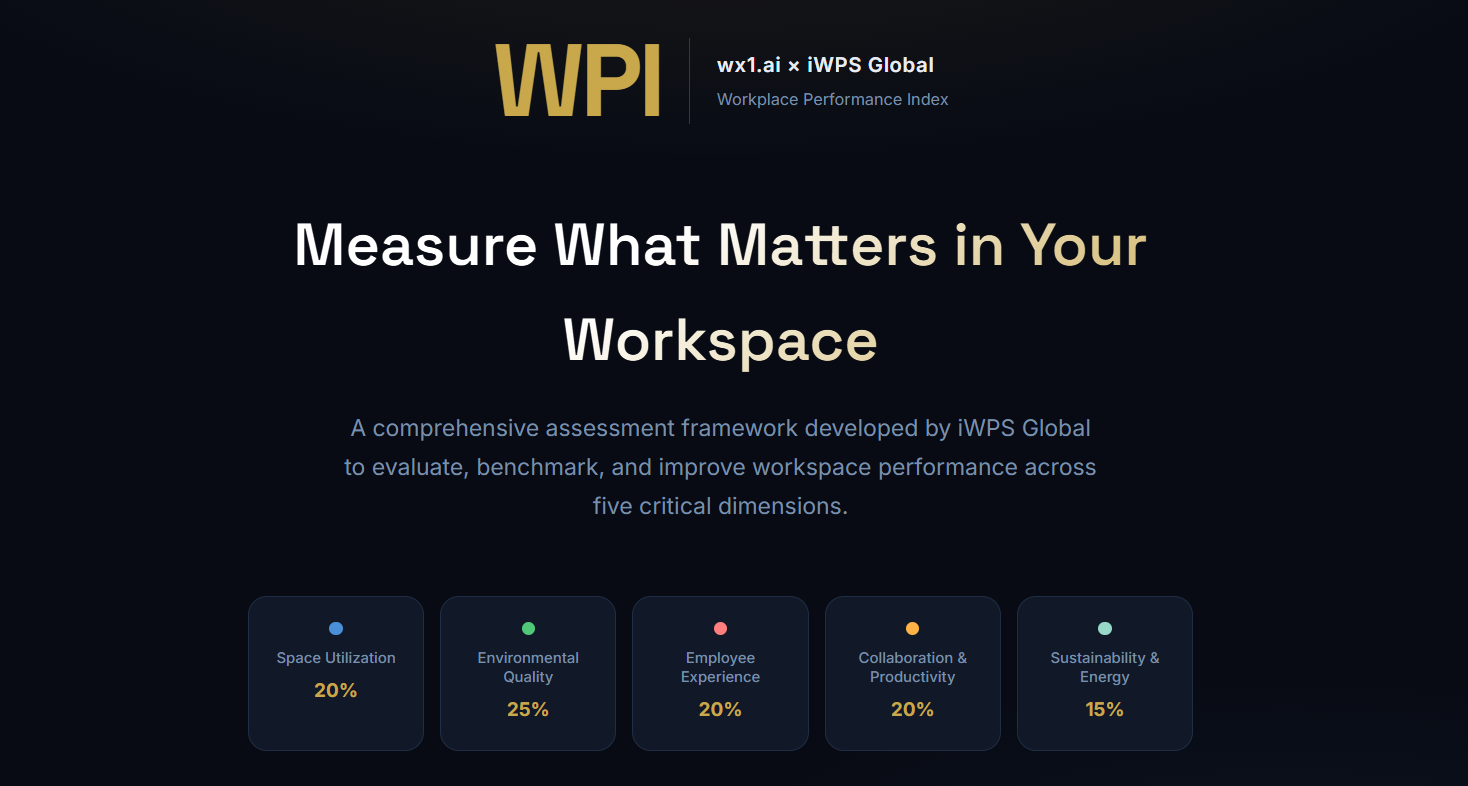
Modern offices generate enormous amounts of workplace data. However, most organisations still struggle to answer one important question:
Is our workplace performing well?
The Workplace Performance Index (WPI) provides a single performance score that measures workplace effectiveness across utilisation, energy, employee experience, MEP performance, and design outcomes. This article explains how WPI helps organisations make better workplace decisions using measurable data.
What Is the Workplace Performance Index ?
The Workplace Performance Index is a single, composite score between 0 and 100 that measures how well a workplace is performing across six critical dimensions.
You can view how the WPI framework works in detail here: wpi.iwpsglobal Think of it as a CIBIL score for your office building — a standardised, objective measure that any stakeholder can understand at a glance.
A WPI score of 82 means your workplace is in the top 15% globally. Your space is being used efficiently, your energy costs are optimised, your employees report high satisfaction, and your MEP systems are performing as designed.
A WPI score of 41 means your investment is underperforming. You’re likely paying for space you don’t use, your energy bills are higher than they should be, and the design decisions made during procurement aren’t translating into real-world outcomes.
The Six Dimensions of the Workplace Performance Index
The WPI doesn’t rely on a single metric. It synthesises data across six dimensions, each weighted according to the building type, usage pattern, and organisational priorities:
Space Utilisation Efficiency: How effectively is every square foot of leased space being used? In India’s hybrid work environment, where average office occupancy hovers between 50–70% on any given day, this dimension alone can reveal whether a company is paying for 30% more space than it needs.
Energy & Sustainability Performance: With over 80% of new Indian office supply being green-certified, energy performance is no longer optional. WPI measures actual energy consumption against certified benchmarks, identifying the gap between what the building was designed to deliver and what it actually delivers.
Employee Productivity Correlation: This is where WPI goes beyond traditional facility metrics. Using anonymised productivity data, movement patterns, and collaboration analytics, WPI establishes a statistical correlation between workplace design decisions and measurable productivity outcomes.
Occupant Satisfaction Index: Based on structured surveys and real-time feedback systems, this dimension captures how the people who use the building every day actually feel about it. Temperature, lighting, noise, air quality, amenities, and commute experience all factor in.
MEP Systems Performance: Mechanical, electrical, and plumbing systems are the hidden infrastructure that makes or breaks an office. WPI measures HVAC efficiency, electrical load balancing, water management, and fire safety system compliance against design specifications.
Design-to-Outcome Alignment: Did the workplace deliver what the design promised? This dimension compares the original design intent (submitted during procurement) against post-occupancy reality. It’s the accountability layer that procurement teams have been asking for.
Why Procurement Teams Need the Workplace Performance Index
India’s CRE procurement cycle is notoriously complex. A typical Grade A office fit-out involves multiple vendors, extended approval chains, and budgets that can shift by 20–30% between initial estimates and final costs. In this environment, procurement leaders face three persistent challenges:
-
- No pre-fit-out baseline: Without knowing how the current workplace performs, it’s impossible to set meaningful targets for the new one. WPI provides that baseline.
-
- No objective way to evaluate bids: When five fit-out vendors promise “world-class workplaces,” how do you compare them? WPI-aligned specifications give procurement teams a measurable standard to hold vendors accountable.
-
- No post-occupancy proof of ROI: The CFO asks, “Did our ₹20 Crore investment deliver?” Without WPI, the answer is anecdotal. With WPI, it’s a number.
Why IWPS Built the Workplace Performance Index
There are over 50,000 proptech companies globally. Many offer point solutions: sensor platforms, space booking tools, energy monitoring dashboards, employee survey apps. But none of them have built a unified index that synthesises all of these data streams into a single, actionable score.
The reason is simple: building WPI requires deep domain expertise in workplace strategy, interior design, MEP engineering, and data science — simultaneously. It requires having worked inside hundreds of buildings across multiple countries and understanding how design decisions translate (or fail to translate) into real-world performance.
IWPS Global has spent over two decades doing exactly that. wx1.ai is the technology platform that operationalises that expertise. WPI is just one of six proprietary tools in the IWPS suite — alongside the Digital Twin, MEP Estimator, Zoning Visualiser, Intelligent Infrastructure Platform (IIP), and Space Calculator. No other company in the world has all six.
Frequently Asked Questions
What is the Workplace Performance Index?
The Workplace Performance Index (WPI) is a scoring framework that measures workplace performance across utilisation, energy, employee experience, MEP systems, and design outcomes.
How is the Workplace Performance Index calculated?
The Workplace Performance Index combines multiple workplace performance indicators into a weighted score between 0 and 100, helping organisations evaluate office performance objectively.
Who should use the Workplace Performance Index?
Facility managers, procurement leaders, workplace strategists, corporate real estate teams, HR leaders, and organisations planning office investments.
How does WPI improve office performance?
WPI identifies performance gaps across workplace utilisation, energy efficiency, employee satisfaction, and building systems, helping organisations make better workplace decisions.
Key Takeaways
- WPI measures workplace performance using a single score.
- Workplace analytics improve business decisions.
- Procurement teams gain measurable benchmarks.
- Organisations optimise office investments.
- Better workplace data improves ROI.
- WPI supports continuous workplace improvement.
Get your Workplace Performance Index Assessment
Whether you’re planning a new office, renewing a lease, or improving an existing workplace, the Workplace Performance Index helps you understand how your office performs before making major investment decisions.
Request a Workplace Performance Index assessment to discover opportunities for better space utilisation, energy efficiency, employee experience, and operational performance.
If you’d like a sample WPI report tailored to your industry, feel free to connect with the team at https://iwpsglobal.com/ or reach out directly on LinkedIn.