 By Archie J Abraham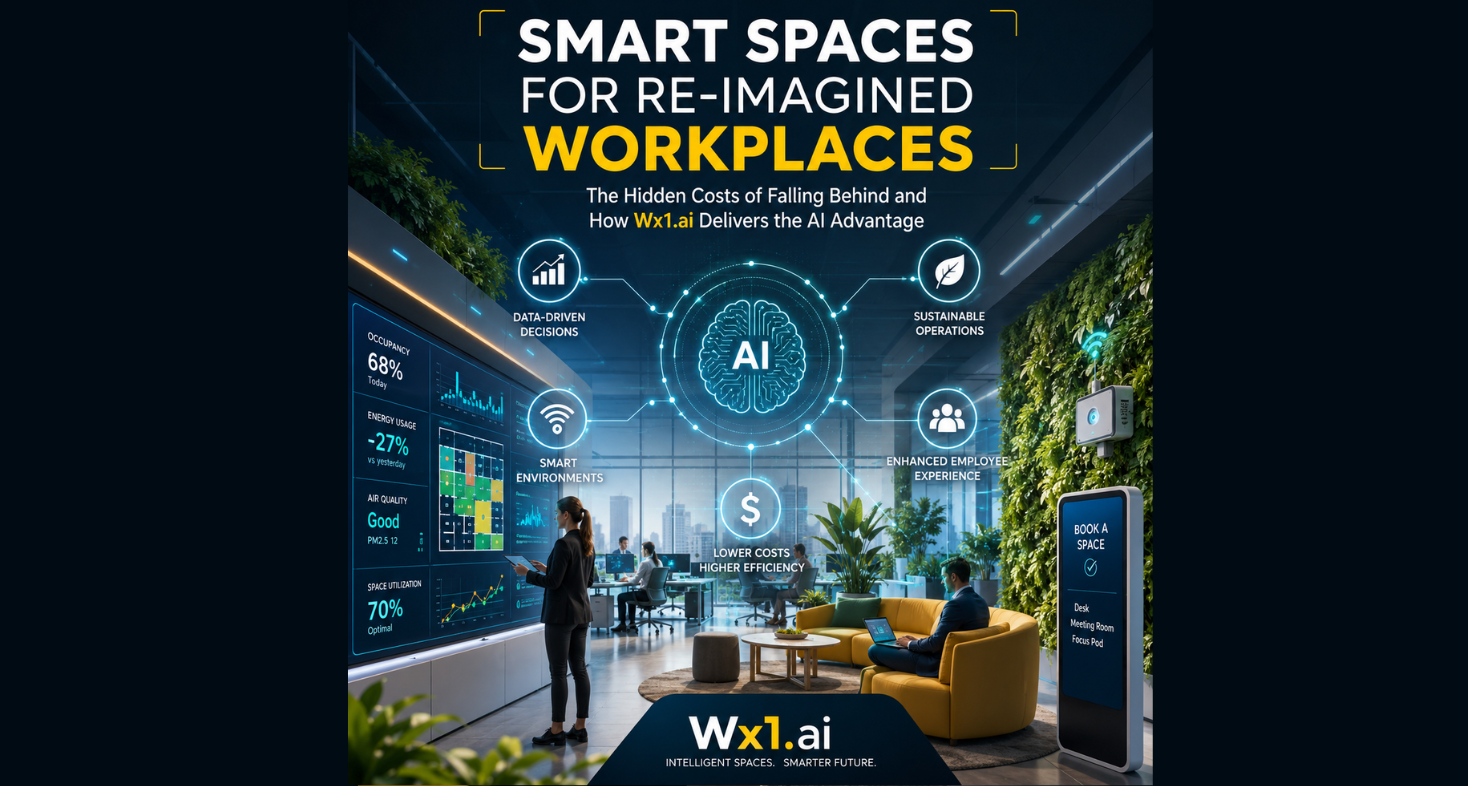
Modern organisations need workplaces that do more than provide office space. They need intelligent environments that improve employee experience, reduce operating costs, and support long-term business growth.
Smart Workplace Solutions combine AI, IoT, workplace analytics, and automation to create adaptive workplaces that continuously improve performance. This article explores why businesses are investing in intelligent workplaces and how Wx1.ai helps organisations accelerate that transformation.
What Are Smart Workplace Solutions?
Smart spaces represent the convergence of artificial intelligence, Internet of Things (IoT), and advanced analytics to create adaptive, responsive work environments that optimize both employee experience and operational efficiency. At their core, these intelligent environments leverage real-time data from thousands of sensors, integrated building management systems, and user applications to continuously learn, adapt, and improve.
The Optus research demonstrates that intelligent building systems go far beyond basic automation. They encompass AI-powered workplace optimization through:
Network-Centric Architecture: High-density Wi-Fi 6 infrastructure supporting seamless connectivity for multiple devices, IoT sensors, and bandwidth-intensive applications. This foundation enables secure network segmentation that protects sensitive data while maintaining operational flexibility.
Data-Driven Decision Making: Environmental sensors monitoring temperature, air quality, occupancy, and noise levels feed into centralized analytics platforms. Advanced AI algorithms analyze this data to optimize HVAC systems, lighting schedules, and space allocation in real-time, responding to actual usage patterns rather than predetermined schedules.
Personalized Employee Experiences: Smart workplace solutions integrate mobile applications with building systems, allowing individuals to control their immediate environment, book workspaces, and navigate complex office layouts. These systems learn individual preferences and automatically adjust settings as employees move throughout the building.
Predictive Maintenance and Operations: Machine learning algorithms analyze equipment performance data to predict failures before they occur, reducing downtime and maintenance costs while ensuring consistent environmental comfort.
The transformation extends to space utilization optimization, where real-time occupancy data challenges traditional assumptions about workspace design. Leading implementations have proven that lower desk-to-employee ratios are achievable without sacrificing productivity when supported by intelligent resource allocation systems.
The Hidden Costs of Delaying Smart Workplace Transformation
Organizations delaying smart building implementation face mounting hidden costs that extend far beyond initial capital expenditure concerns. Research from Gartner reveals that unplanned downtime in outdated office systems costs organizations up to $5,600 per minute in lost productivity, while buildings account for 23% of national emissions – making sustainability improvements both environmentally and economically imperative.
Space Inefficiency Penalties: Traditional office spaces operate at only 49-68% occupancy rates, significantly below the 70% benchmark for efficient utilization. Organizations maintaining inefficient space allocation effectively subsidize unused square footage while missing opportunities for consolidation or revenue generation through subletting. For a mid-sized organization occupying 50,000 square feet at $30 per square foot annually, improving utilization from 50% to 70% represents potential savings of $300,000 per year.
Energy Waste and Operational Inefficiency: Buildings without intelligent automation systems consume 30-50% more energy than optimized smart buildings. For organizations with substantial office footprints, this translates to hundreds of thousands in annual energy costs. Additionally, reactive maintenance approaches cost 3-4 times more than predictive maintenance strategies enabled by AI-powered monitoring systems.
Talent Attraction and Retention Challenges: Research from the International WELL Building Institute demonstrates that employees in optimized work environments experience 19% decreased absenteeism, 58% reduction in sick days, and 27% lower staff turnover. Organizations without modern workplace amenities face recruitment disadvantages and higher replacement costs, with employee turnover costing 50-200% of annual salary depending on role complexity.
Compliance and Security Vulnerabilities: Legacy building systems lack the security frameworks necessary for modern data protection requirements. Organizations face potential regulatory violations, cybersecurity risks, and the inability to implement comprehensive monitoring necessary for health and safety compliance.
Innovation and Competitive Disadvantages: Companies without digital workplace capabilities struggle to implement hybrid work models, real-time collaboration tools, and the flexibility that modern workforces demand. This technological gap compounds over time, making future upgrades more complex and expensive.
How Smart Workplace Solutions Improve Business Performance
Smart workplace technologies deliver measurable improvements across multiple operational dimensions, creating compound benefits that justify implementation investments through both hard and soft ROI metrics.
Real-World Success Stories: The Edge in Amsterdam, featuring 28,000 sensors and AI-driven optimization, demonstrates the practical potential of fully integrated smart buildings. Tenants report enhanced employee satisfaction through personalized environmental controls, while the building achieves remarkable energy efficiency through data-driven HVAC and lighting management. The system’s granular occupancy data has fundamentally challenged conventional workspace design assumptions, proving that innovative approaches to space utilization can maintain productivity with reduced footprints.
Similarly, Frasers Tower in Singapore showcases smart building transformation in dense urban environments. The building’s touchless access systems and mobile-enabled environmental controls create frictionless experiences for tenants while comprehensive sensor networks provide data for continuous optimization. These implementations represent blueprints for organizations seeking to understand the practical benefits of intelligent workplace design.
Operational Excellence Through AI Integration: Machine learning algorithms analyze patterns in space usage, identifying opportunities for efficiency gains and predicting potential issues before they impact employee experience. For example, AI can determine optimal meeting room configurations based on team size preferences, automatically adjust HVAC systems based on occupancy forecasts, and provide facilities managers with actionable insights for space reallocation decisions.
Employee Experience Enhancement: Personalized workplace applications integrate seamlessly with building systems to create context-aware experiences. Employees can reserve workspaces based on specific amenities (dual monitors, adjustable desks, proximity to teammates), receive real-time navigation assistance through complex office layouts, and automatically have their environmental preferences applied as they move between locations.
Sustainability and Cost Reduction: AI-powered building optimization reduces energy consumption through intelligent scheduling of lighting, HVAC, and equipment based on actual usage patterns rather than fixed schedules. Organizations typically achieve 20-30% energy cost reductions within the first year of implementation, with additional savings emerging from predictive maintenance reducing equipment replacement costs and emergency repair expenses.
Data-Driven Decision Making: Comprehensive analytics platforms provide facility managers and leadership teams with unprecedented visibility into workspace utilization, employee preferences, and operational efficiency metrics. This data enables evidence-based decisions about lease renewals, space reconfigurations, and technology investments rather than relying on assumptions or limited observational data.
Why Choose wX1.ai for Smart Workplace Solutions?
As organizations recognize the imperative for smart workplace transformation, wX1.ai emerges as the strategic partner capable of delivering comprehensive AI-driven workplace solutions that bridge the gap between technological potential and practical implementation.
Comprehensive AI-Powered Platform: wX1.ai specializes in developing integrated intelligent workplace systems that combine advanced sensor networks, machine learning analytics, and user-centric applications into cohesive platforms. Our approach begins with understanding each organization’s unique operational requirements, existing technology infrastructure, and strategic objectives to design customized solutions that deliver measurable results.
Advanced Space Optimization: Our AI algorithms analyze multiple data streams – occupancy sensors, booking systems, environmental controls, and user feedback – to provide real-time recommendations for space utilization optimization. Organizations working with wX1.ai typically achieve 25-40% improvements in space efficiency within six months of implementation, translating to significant cost savings and enhanced employee satisfaction.
Predictive Analytics and Maintenance: wX1.ai’s machine learning models continuously monitor building systems performance, identifying patterns that predict equipment failures, optimize energy consumption, and prevent costly downtime. Our predictive maintenance capabilities reduce emergency repair costs by up to 60% while extending equipment lifespan through intelligent scheduling and preventive interventions.
Employee Experience Personalization: Our platform integrates seamlessly with existing workplace applications to create personalized experiences that adapt to individual preferences and work patterns. Employees benefit from intelligent workspace recommendations, automated environmental adjustments, and contextual information delivery that enhances productivity and satisfaction.
Implementation and Change Management: wX1.ai provides comprehensive support throughout the transformation process, including change management strategies, employee training programs, and ongoing optimization services. Our phased implementation approach minimizes disruption while enabling organizations to realize benefits quickly and build momentum for broader adoption.
Security and Compliance: Understanding the critical importance of data privacy and security, wX1.ai implements robust security frameworks that protect sensitive information while enabling comprehensive analytics. Our solutions comply with relevant regulations including GDPR, ensuring organizations can leverage powerful AI capabilities without compromising employee privacy or regulatory compliance.
Scalable Architecture: wX1.ai designs solutions with future growth in mind, ensuring that initial implementations can seamlessly expand as organizations grow or requirements evolve. Our cloud-based architecture supports multi-location deployments while maintaining centralized management and analytics capabilities.
Business Benefits and ROI
Organizations implementing wX1.ai’s smart workplace solutions typically achieve compelling return on investment through multiple value streams:
Quantifiable Cost Savings: Energy cost reductions of 20-30%, space optimization savings of 15-25%, and maintenance cost reductions of 40-60% create substantial annual savings that often justify implementation costs within 18-24 months.
Productivity and Satisfaction Gains: Employees in AI-optimized workplaces report 15-20% improvements in workspace satisfaction, while organizations experience reduced absenteeism and turnover rates that translate to significant cost avoidance.
Operational Efficiency: Facilities management teams achieve 30-50% improvements in response times for space allocation, maintenance requests, and environmental adjustments through automated workflows and predictive analytics.
Future-Proofing Value: Organisation with wX1.ai implementations are positioned to rapidly adapt to changing workplace requirements, whether driven by hybrid work models, regulatory changes, or evolving employee expectations.
Conclusion: The Imperative for Intelligent Workplace Transformation
The transformation to smart workplaces represents more than a technology upgrade – it’s a strategic imperative that defines organizational competitiveness in the modern economy. As the Optus white paper demonstrates through real-world examples like The Edge and Frasers Tower, the benefits of intelligent workplace design extend across operational efficiency, employee satisfaction, sustainability goals, and financial performance.
Organizations that delay this transformation risk more than missed opportunities; they face mounting costs from inefficient operations, employee dissatisfaction, and competitive disadvantages that compound over time. The question facing leadership teams isn’t whether to implement AI-driven workplace solutions, but how quickly they can partner with experienced providers to realize these benefits.
wX1.ai stands ready to guide organisations through this transformation, providing comprehensive smart workplace technologies that deliver measurable results while positioning companies for future success. Our expertise in artificial intelligence, IOT integration, and workplace optimization ensures that investments in smart spaces generate both immediate returns and long-term competitive advantages.
The future of work is intelligent, adaptive, and employee-centric. Organizations that embrace this transformation today will lead their industries tomorrow, while those who delay will find themselves increasingly disadvantaged in the race for talent, efficiency, and market leadership. The choice is clear: evolve to smart workplaces now, or risk obsolescence in an increasingly competitive landscape.
“Ready to modernise your workplace?”
Discover how Wx1.ai helps organisations implement AI-powered smart workplace solutions that improve efficiency, sustainability, and employee experience. https://wx1.ai/