
 By Archie J Abraham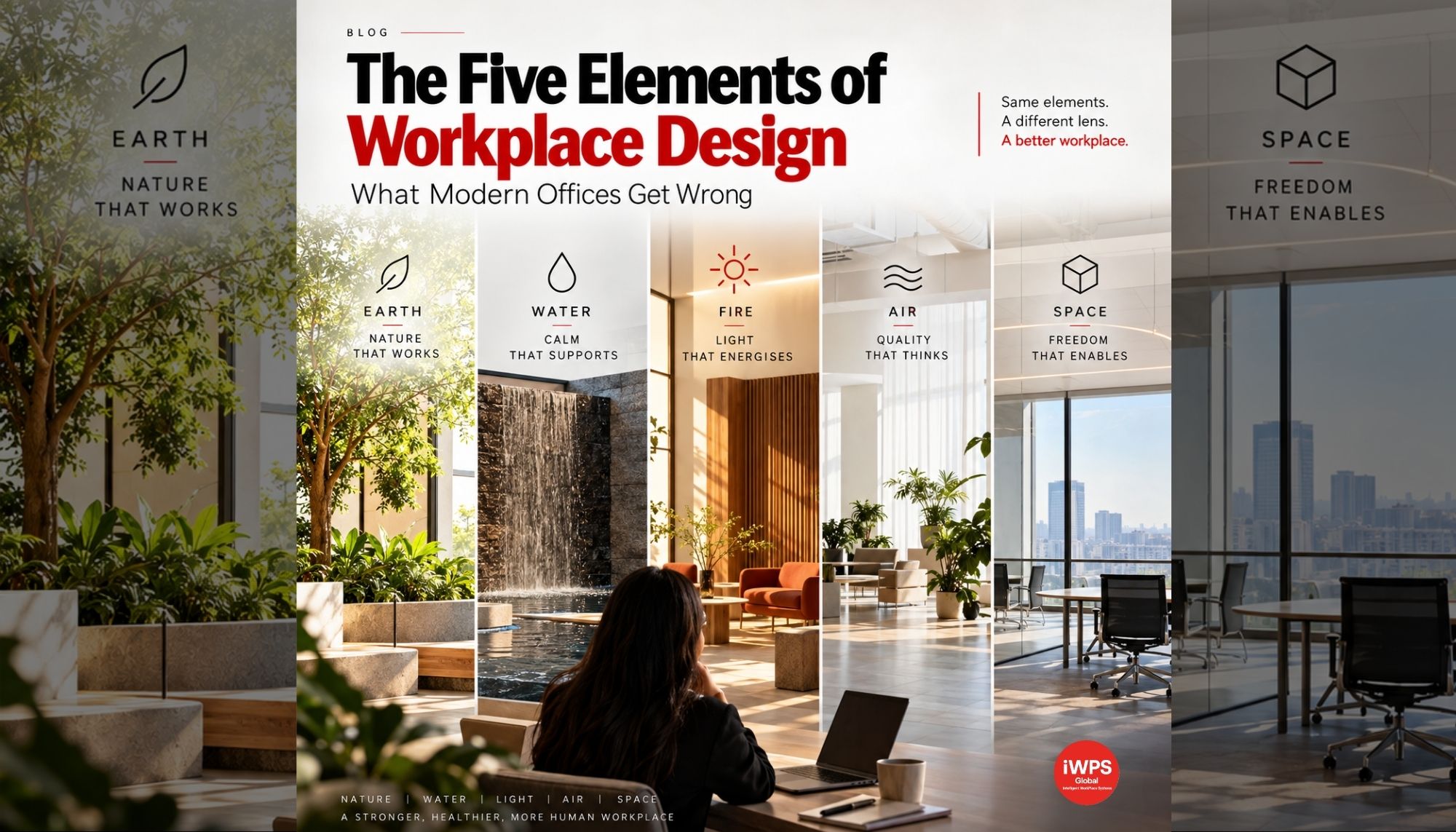
Panchabhuta is an ancient framework built around five elements: earth, water, fire, air and space.
Long before the modern office existed, the idea was that a built environment was not complete when it simply had walls, furniture and structure. A space also needed the qualities associated with these five elements.
Thousands of years later, modern workplace research is exploring many of the same environmental conditions from a very different perspective.
Nature affects how people interact with their surroundings. Water can influence visual restoration. Light affects the body’s biological rhythms. Air quality can influence cognitive performance. Even the volume of a room can affect how people think.
The terminology has changed.
The underlying question has not:
What does a workplace need to support the people inside it?
The answer may be more than desks, meeting rooms and attractive interiors.
The five elements offer an interesting framework for looking at what modern offices sometimes overlook. The IWPS Global newsletter examined the evidence behind each one, revealing where common workplace assumptions hold up—and where they do not.
1. Earth: Nature Needs to Be Real, Not Decorative
Biophilic design has become increasingly common in modern offices.
Plants, greenery, natural materials and views of nature are now familiar features of workplace interiors.
However, the newsletter highlights an important distinction: seeing real greenery is different from simply adding decorative references to nature.
One study cited in the newsletter found that employees with real greenery within their sightline completed tasks 15% faster than employees in an otherwise identical bare office, without an increase in errors.
That creates an important design question.
Is the plant actually part of the employee’s visual environment?
Or is it simply an object placed somewhere in the office?
A planter hidden behind a workstation may technically make an office “green.” But workplace design should consider visibility, placement and the relationship between people and nature rather than simply counting plants.
What this means for workplace design
Nature should be integrated intentionally through:
- visible greenery
- access to natural views
- appropriate planting locations
- natural materials
- visual connection to outdoor environments
The goal is not to make an office look green.
It is to create meaningful connections between people and the natural environment.
2. Water: The Instinct Is Right, But the Application Matters
Water is often associated with calmness and restoration.
That has led some workplaces to introduce fountains and water features, particularly in reception areas, lounges and wellness spaces.
But the newsletter presents a more nuanced finding.
A study involving 18 weeks of observation in a working open-plan office with 77 staff compared water-based sound masking with a conventional masking generator. The water-based approach did not perform better for speech masking; colleagues’ conversations could actually sound more disturbing.
This creates a useful distinction:
Water may have visual value without being the right solution for acoustic problems.
In other words, an element can be useful for one workplace experience while being unsuitable for another.
The newsletter points toward the restorative value of blue space while separating that from the technical problem of speech masking.
What this means for workplace design
If water is introduced into a workplace, designers should first understand why it is being introduced.
Is the objective:
- visual restoration?
- a sense of calm?
- an experience feature?
- acoustic masking?
The answer determines whether a water feature is actually the appropriate intervention.
Good workplace design is not about adding attractive features.
It is about matching each intervention to a clearly defined workplace need.
3. Fire: Lighting Needs to Be Measured Differently
In the modern workplace, fire’s closest environmental counterpart is light.
And lighting has become an increasingly important part of workplace wellbeing discussions.
Terms such as circadian lighting and tunable lighting are now common in office specifications.
However, the newsletter highlights an important technical issue: colour temperature alone does not tell us how light affects the body’s circadian system.
The newsletter references the 2022 international consensus around melanopic EDI, which considers the biological effect of light rather than simply its visual colour. It highlights a daytime target of at least 250 lux of melanopic EDI at eye level, measured vertically.
This changes the question designers should ask.
Instead of:
“What colour temperature are we specifying?”
the conversation can become:
“What biological light exposure are occupants actually receiving?”
Measurement matters because a lighting system can be marketed as “tunable” without necessarily being evaluated using the measurement approach relevant to circadian lighting.
What this means for workplace design
Lighting strategy should consider:
- daylight availability
- task requirements
- glare
- visual comfort
- lighting distribution
- biological effects
- actual measurements at occupant eye level
The specification is only the beginning.
The workplace experience depends on what people actually receive.
4. Air: The Invisible Workplace Element
Air is one of the easiest workplace conditions to overlook because it is largely invisible.
Employees may not notice a gradual increase in CO₂.
But the newsletter highlights research suggesting that cognitive performance can deteriorate as CO₂ levels rise in enclosed meeting environments, even before occupants describe the room as uncomfortable.
This creates an important distinction between compliance and performance.
A room can meet basic safety requirements while still providing an environment that is not optimal for demanding cognitive work.
For offices, this is especially relevant in meeting rooms.
A small room occupied by several people can experience changing air conditions throughout a meeting. If ventilation is not appropriately considered, the environment can change while the discussion continues.
What this means for workplace design
Air quality should be treated as part of workplace performance rather than simply a building-services requirement.
Workplace teams can consider:
- ventilation
- CO₂ monitoring
- meeting-room occupancy
- air movement
- indoor air quality
- HVAC performance
- occupant comfort
The key point is simple:
You cannot judge workplace air quality by appearance.
It needs to be measured.
5. Space: The Dimension We Often Treat as a Structural Given
The fifth element is space, or Akash.
In conventional office planning, ceiling height can easily become something designers inherit rather than something they consciously consider.
But the newsletter references research suggesting that ceiling volume can influence how people think, with higher ceilings associated with more abstract thinking and lower ceilings with more detail-oriented thinking.
This raises an interesting question about workplace planning.
Do all activities need exactly the same spatial conditions?
A workplace contains very different cognitive and social activities:
- focused work
- creative thinking
- collaboration
- learning
- meetings
- individual concentration
- informal interaction
Yet many offices treat spatial volume as a uniform condition across an entire floor.
What this means for workplace design
Space planning can go beyond:
How many square feet do we have?
It can also consider:
What type of environment does each activity require?
That includes not only floor area, but also:
- ceiling volume
- density
- enclosure
- openness
- privacy
- circulation
- spatial hierarchy
Space is not merely the container for work.
It can influence the experience of work itself.
The Five Elements of Workplace Design: Five Questions to Ask
The value of the five-element framework is not that every modern office needs to literally recreate an ancient system.
Its value is that it encourages workplace teams to look beyond the obvious.
| Element | Workplace interpretation | Key question |
|---|---|---|
| Earth | Nature & biophilia | Can people genuinely connect with nature? |
| Water | Visual restoration & experience | Are environmental features being used for the right purpose? |
| Fire | Light & biological response | Are lighting conditions actually being measured? |
| Air | Indoor environmental quality | Is air quality supporting the work people need to do? |
| Space | Spatial volume & experience | Does the environment suit different types of work? |
The newsletter’s own self-check applies these questions directly to the workplace: whether employees can see real plants, whether water is visible, whether light is measured at eye level, whether meeting rooms have CO₂ sensors and whether ceiling height changes across the floor.
From Beautiful Offices to Measurable Workplace Performance
This is where the conversation becomes particularly relevant to modern workplace strategy.
A workplace can look impressive in photographs and still perform poorly in practice.
A green wall does not automatically create a biophilic workplace.
A decorative water feature does not automatically solve acoustic problems.
A tunable lighting system does not automatically guarantee appropriate circadian exposure.
A compliant HVAC system does not automatically mean every meeting room has ideal air conditions.
And a large open floor plate does not automatically support every type of work.
The difference is measurement.
Workplace design increasingly needs to connect visual decisions with measurable outcomes.
That means asking:
What are we designing?
Why are we designing it?
How will we know whether it works?
How IWPS Global Can Translate These Principles Into Workplace Strategy
For IWPS Global, these five elements can be viewed as a starting framework for connecting design decisions with workplace performance.
The Workplace Performance Score can help organisations move beyond subjective assessments of whether an office “looks good” and examine workplace performance through measurable indicators.
That approach is particularly relevant when evaluating:
- space utilisation
- employee experience
- workplace efficiency
- environmental conditions
- collaboration
- productivity-related workplace indicators
The broader principle is simple:
A workplace should not only be designed. It should be evaluated.
The five elements provide a useful lens for asking what may be missing.
Workplace analytics can then help organisations understand whether those decisions are actually supporting the way people work.
A Five-Element Workplace Self-Check
Before your next workplace redesign or fit-out, ask five simple questions:
Earth
Can employees see and meaningfully experience real nature?
Water
Are water features being used for a defined purpose rather than simply as decoration?
Fire
Has workplace lighting been measured at occupant eye level?
Air
Can indoor air conditions be monitored in high-occupancy spaces such as meeting rooms?
Space
Does the spatial environment support different types of work and thinking?
The newsletter suggests that answering “yes” to all five is uncommon.
That makes the framework less of a checklist and more of a prompt:
What has your workplace overlooked?
The Bigger Lesson: Design What You Can Measure
Ancient design theory and modern workplace science come from very different worlds.
Yet both point toward the idea that a built environment affects more than what people see.
Nature, light, air, sound and spatial conditions can influence how people experience and use a workplace.
The lesson for today’s workplace leaders is not to copy an ancient framework literally.
It is to question whether modern offices have become too focused on what is easy to specify and measure—desks, square footage, finishes and furniture—while overlooking the environmental conditions that shape everyday work.
A high-performing workplace is not simply a beautiful space. It is a space whose important conditions are intentionally designed, measured and improved.
Conclusion: Your Office May Be Missing More Than You Think
The five elements offer an unusual but useful way to rethink workplace design.
Earth reminds us that nature should be experienced, not simply displayed.
Water reminds us that environmental interventions need a clear purpose.
Fire reminds us that lighting should be measured by more than colour temperature.
Air reminds us that invisible environmental conditions can affect how people work.
Space reminds us that the physical environment is not simply a structural container.
Together, they point to a larger principle:
Workplace design should connect environmental quality with how people actually work.
The question is no longer simply whether an office looks complete.
It is whether the workplace is performing as intended.
And sometimes, the first step is simply knowing what to look for.
Visit: https://iwpsglobal.com/ || https://blogs.iwpsglobal.com/
Explore: https://wx1.ai/
Connect with us on LinkedIn
Frequently Asked Questions
What are the five elements of workplace design?
The five elements are earth, water, fire, air and space, inspired by the Panchabhuta framework. In a modern workplace context, they can be interpreted through nature, water features, lighting, air quality and spatial conditions.
How does nature affect workplace design?
Research cited in the IWPS Global newsletter found that real greenery within an employee’s sightline was associated with faster task completion without an increase in errors.
Can water features improve office acoustics?
Not necessarily. The newsletter cites research from an open-plan office where water-based masking did not outperform a conventional masking generator. Water may have visual or restorative value, but it should not automatically be treated as an acoustic solution.
What is melanopic EDI?
Melanopic EDI is a measure used to describe the biological effect of light on the human circadian system. The newsletter references the 2022 international consensus and highlights measurement at eye level rather than relying only on conventional lighting specifications.
Why is air quality important in meeting rooms?
Enclosed meeting rooms can experience rising CO₂ levels as occupancy increases. The newsletter highlights research connecting elevated CO₂ with deterioration in higher-order cognitive performance before occupants necessarily perceive the room as stuffy.
Can ceiling height affect workplace experience?
The newsletter references research suggesting that ceiling volume can influence cognitive processing, with higher ceilings associated with more abstract thinking and lower ceilings with more detailed thinking.
How can companies evaluate workplace performance?
Companies can combine workplace design with measurable workplace data to evaluate factors such as space utilisation, environmental conditions, employee experience and workplace performance rather than relying only on visual assessment.
Sources
The newsletter cites the following research:
- Nieuwenhuis et al., Journal of Experimental Psychology: Applied, 2014
- Hongisto et al., Frontiers in Psychology, 2017
- White et al., Environmental Research, 2020
- Brown et al., PLOS Biology, 2022
- Meyers-Levy & Zhu, Journal of Consumer Research, 2007
IWPS Global — Where Art Meets Algorithms
[…] a workplace, from nature and lighting to air quality and spatial experience. Our guide to the five elements of workplace design explores these factors in more detail.For […]