
 By Archie J Abraham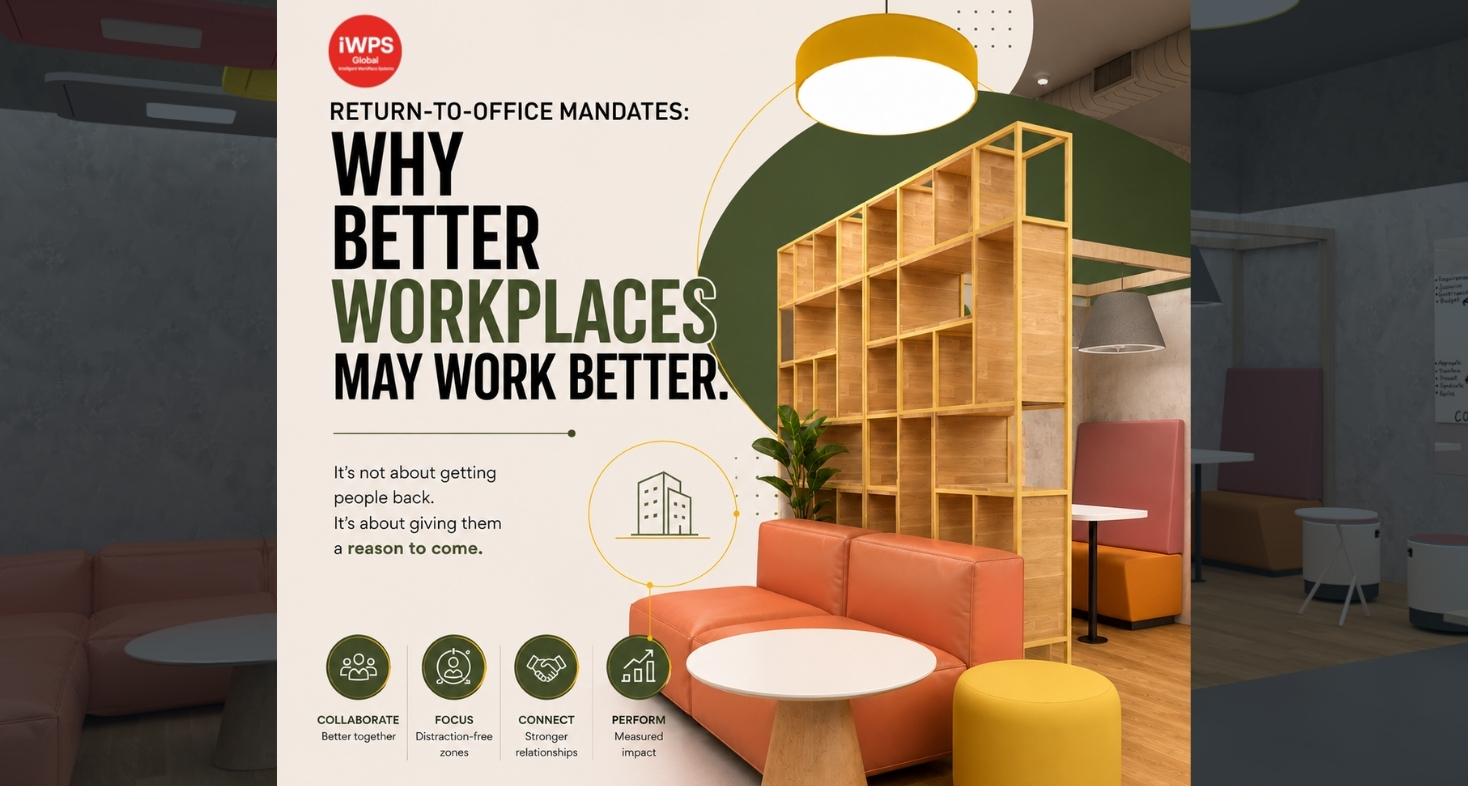
The return to the office has become one of the biggest workplace debates of recent years.
As organisations move beyond fully remote work, many have introduced return-to-office mandates to bring employees back for a fixed number of days each week. The expectation is simple: more people in the office should mean stronger collaboration, better culture, and higher performance.
But physical presence alone does not guarantee better workplace outcomes.
The more important question is:
What makes employees want to use the workplace in the first place?
Recent research into companies implementing return-to-office policies raises important questions about whether mandatory attendance alone delivers the expected business benefits. For workplace leaders, this creates an opportunity to rethink the role of the office—not as a place employees are required to occupy, but as an environment that creates genuine value.
What Are Return-to-Office Mandates?
Return-to-office mandates are policies that require employees to work from a physical office for a specific number of days or hours.
Organisations typically introduce these policies to encourage:
- Face-to-face collaboration
- Team connection
- Knowledge sharing
- Organisational culture
- Innovation
- Manager-employee interaction
These objectives are understandable. However, bringing employees into an office does not automatically improve the quality of their work experience.
If employees arrive at an office only to spend the day on video calls, work in noisy environments, struggle to find meeting rooms, or sit at underused desks, the physical workplace may not be delivering its intended value.
Does Office Attendance Automatically Improve Performance?
One of the biggest mistakes in workplace strategy is treating attendance as a measure of performance.
An occupancy dashboard can tell you how many people entered a building.
It cannot tell you:
- Whether teams collaborated effectively
- Whether employees could focus
- Whether meeting spaces supported their needs
- Whether the workplace improved employee experience
- Whether leased space was being used efficiently
- Whether the office contributed to business performance
Research examining return-to-office mandates at S&P 500 companies found no significant improvement in financial performance or firm value following the mandates studied. It also reported declines in job satisfaction, work-life balance, and trust in management at 99% of mandating companies.
The takeaway is not that offices no longer matter.
It is that office attendance and workplace performance are not the same thing.
Why Employees May Resist Returning to the Office
Employees are not necessarily opposed to physical workplaces.
In many cases, they are questioning whether the office provides enough value to justify the commute.
A home workspace may offer:
- Fewer interruptions
- Greater control over the environment
- Easier concentration
- Flexible working hours
- No commute
The office needs to offer something different.
Employees are more likely to value workplace attendance when the office provides better opportunities for:
- Collaboration
- Social connection
- Learning
- Innovation
- Team interaction
- Access to technology
- Focused work
- Informal conversations
This changes the role of workplace design.
The objective is no longer simply to accommodate employees.
It is to create an environment that supports the reason they are there.
From Return-to-Office Policy to Workplace Strategy
A return-to-office policy answers one question: When should employees come to the office?
A workplace strategy answers a much more important question: What should employees be able to accomplish when they are there?
That distinction can influence everything from floor planning to technology, furniture, meeting spaces, and employee experience.
These decisions are also shaped by the environmental conditions within a workplace, from nature and lighting to air quality and spatial experience. Our guide to the five elements of workplace design explores these factors in more detail.
For example:
Collaboration
Teams need spaces designed for brainstorming, discussion, and problem-solving.
Focus
Employees need quiet environments for work that requires concentration.
Connection
Social spaces can encourage informal interaction and strengthen team relationships.
Learning
Training areas and flexible rooms can support mentoring, workshops, and knowledge sharing.
Innovation
Flexible environments can support experimentation and creative thinking.
When these activities are intentionally supported, office attendance becomes more purposeful.
Why the Modern Workplace Needs Choice
A successful workplace cannot assume that every employee works best in the same environment.
Different tasks require different settings.
A well-planned workplace may include:
| Work activity | Suitable workplace environment |
|---|---|
| Deep focus | Quiet work zones |
| Team collaboration | Collaboration hubs |
| Private discussions | Enclosed meeting rooms |
| Hybrid meetings | Technology-enabled rooms |
| Informal interaction | Social spaces |
| Individual work | Flexible workstations |
This creates a chooseable workplace—an environment where employees can select the setting that best matches their task.
The goal is not to maximise open space or enclosed space.
The goal is to create the right mix of spaces.
Hybrid Work Has Changed the Purpose of the Office
Before hybrid work became widespread, the office was often the default location for almost every type of work.
That model has changed.
Employees can now complete many individual tasks remotely. As a result, the office increasingly needs to focus on activities that benefit from physical presence.
This includes:
- Team collaboration
- Relationship building
- Workshops
- Mentoring
- Creative sessions
- Client interactions
- Social connection
Workplace design should therefore reflect actual work patterns rather than simply reproduce traditional office layouts.
Measure Workplace Performance Before Changing Attendance Policies
Before increasing office attendance, organisations should understand how their existing workplace performs.
Workplace analytics can provide insights into:
- Daily occupancy patterns
- Space utilisation
- Meeting-room demand
- Collaboration behaviour
- Peak attendance days
- Underused areas
- Employee experience
- Workplace efficiency
For example, if employees consistently visit the office on Tuesdays and Wednesdays but large areas remain unused on other days, the organisation has an opportunity to rethink its space strategy.
Likewise, if collaboration spaces are consistently overcrowded while individual desks remain empty, the solution may not be increasing attendance.
It may be redesigning the workplace mix.
The Role of Data-Driven Workplace Design
Traditional workplace decisions often rely on assumptions:
“Our employees need more desks.”
“Everyone should be in the office three days a week.”
“Open-plan space will encourage collaboration.”
Data can challenge these assumptions.
By analysing actual workplace behaviour, organisations can identify:
- Where people naturally collaborate
- Which spaces are consistently occupied
- Which rooms are overbooked
- Where focused work takes place
- Which areas are underutilised
- How employees move between workplace zones
This creates a stronger foundation for workplace planning.
Instead of designing around assumptions, organisations can design around evidence.
Building a Workplace That Employees Choose
The strongest response to the return-to-office debate may not be another attendance policy.
It may be a better workplace.
A workplace that employees choose to use should provide clear value through:
Better collaboration
Spaces that make teamwork easier.
Better focus
Quiet environments that support concentrated work.
Better technology
Seamless tools for both in-person and hybrid collaboration.
Better experience
Comfortable, healthy, and engaging environments.
Better flexibility
Different settings for different workstyles.
When employees have meaningful reasons to come to the office, attendance becomes less dependent on enforcement.
From “Return to Office” to “Reason to Come to Office”
This shift represents an important change in workplace thinking.
Instead of asking:
“How can we get employees back?”
Organisations should ask:
“How can we make the workplace valuable enough that employees want to use it?”
That requires a combination of workplace strategy, intelligent design, technology, and measurable performance data.
The future workplace is unlikely to be defined simply by the percentage of employees present on a particular day.
It will be defined by what those employees are able to achieve when they are there.
What High-Performing Workplaces Will Prioritise
As organisations refine their hybrid workplace strategies, five principles will become increasingly important:
1. Purpose
Every workplace zone should have a clear role.
2. Choice
Employees should have access to different environments for different tasks.
3. Flexibility
Spaces should adapt as teams, workstyles, and business needs change.
4. Measurement
Workplace decisions should be supported by utilisation and performance data.
5. Experience
The physical environment should support employee wellbeing, productivity, and connection.
Together, these principles can transform the office from a mandated destination into a valuable workplace ecosystem.
How IWPS Global Helps Organisations Rethink Workplace Performance
At IWPS Global, we believe workplace strategy should go beyond measuring how many people are present.
Our approach combines workplace strategy, workplace analytics, intelligent systems, and performance measurement to help organisations understand how their spaces actually work.
By measuring workplace behaviour and performance, organisations can make better decisions about space planning, workplace design, hybrid strategies, and employee experience.
The objective is simple:
Build workplaces that people choose—not workplaces people are simply told to occupy.
Final Thoughts
The return-to-office debate has often focused on where employees work.
The next stage of workplace strategy should focus on how the workplace performs.
Attendance matters, but it is only one metric.
A truly effective workplace should support collaboration, focus, connection, flexibility, and employee wellbeing while delivering measurable value to the organisation.
The future may not belong to companies with the strictest return-to-office mandates.
It may belong to companies that build workplaces people have a genuine reason to return to.
Build the magnet. Retire the memo.
Visit: https://iwpsglobal.com/ || https://blogs.iwpsglobal.com/
Explore: https://wx1.ai/
Connect with us on LinkedIn
Frequently Asked Questions
What are return-to-office mandates?
Return-to-office mandates are company policies that require employees to work from a physical office for a specified number of days or hours.
Do return-to-office mandates improve workplace productivity?
Mandatory attendance does not automatically improve productivity. Organisations should also consider workplace design, employee experience, collaboration, space utilisation, and the quality of work performed in the office.
What makes employees want to return to the office?
Employees are more likely to value office attendance when the workplace provides effective collaboration spaces, focus areas, technology, social interaction, flexibility, and a better overall work experience.
What is a chooseable workplace?
A chooseable workplace provides employees with different environments for different activities, allowing them to select spaces that match their work requirements.
How can workplace analytics improve hybrid work?
Workplace analytics can reveal occupancy patterns, space utilisation, collaboration behaviour, meeting-room demand, and underused areas. These insights help organisations make evidence-based workplace decisions.