
 By Archie J Abraham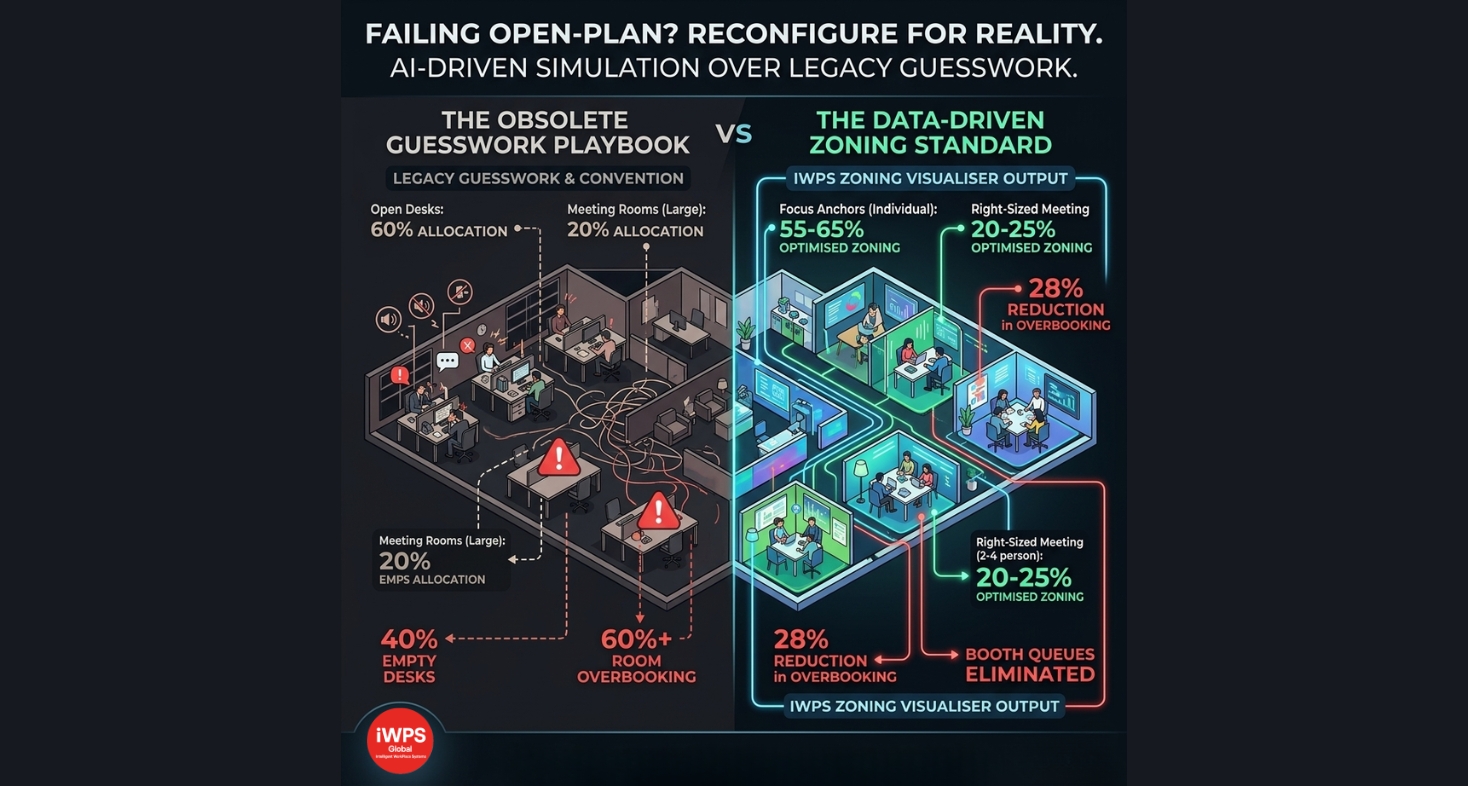
Many organisations still rely on open-plan offices that were designed before hybrid work became the norm. As employee work patterns change, these layouts create overcrowded meeting rooms, unused desks, and limited focus spaces. This article explains why open-plan offices are failing many Indian companies and how data-driven workplace zoning provides a better solution.
The answer is in the zone configuration. And the zone configuration is wrong because it was built for a work pattern that no longer exists.
Open-Plan Offices No Longer Match Today’s Workplace Behaviour
India’s commercial office market adopted open-plan layouts through the 2010s for three overlapping reasons. They reduced the per-seat fit-out cost relative to cellular offices. They signalled a modern, collaborative culture — an important signal for GCC companies establishing India operations to attract global talent. And they reflected the dominant design consensus from the UK and US markets, where open-plan was the default configuration for knowledge-work environments.
These were all reasonable reasons at the time. The problem is that the work pattern assumptions embedded in open-plan design — that knowledge workers primarily need proximity to colleagues for spontaneous collaboration, and that individual focus work can happen anywhere on a shared floor — have been comprehensively disproved by occupancy data from India’s own offices.
What Workplace Utilisation Data Reveals About Open-Plan Offices
Work-mode analysis from Indian GCC and technology offices in 2025 shows a consistent split: 55–60% of in-office time is individual focused work, 20–25% is small-group collaboration involving two to four people, and only 10–15% is the large-group or unplanned interaction that open-plan was primarily designed to facilitate.
The typical open-plan allocation in an Indian Grade A fit-out runs in the opposite direction: 55–65% open workstations (configured for individual work but without acoustic isolation), 15–20% meeting rooms (sized for 6–10 people, the format used least frequently), 10% nominal collaboration zones, and 10% support space. Designers created the floor plan for the 10–15% collaboration pattern. The majority of actual working behaviour — individual focus and small-group work — has no zone optimised for it.
The physical consequence: open-plan desks used for individual work in an acoustically uncontrolled environment. Employees book meeting rooms for two-person conversations because no other private space exists. Focus booths — where they exist — with queues from mid-morning. Employees booking meeting rooms to take calls. And 35–45% of open-plan desks sitting empty daily because employees are either working differently than the floor plan anticipated or have found workarounds that bypass the formal workspace entirely.
Why Open-Plan Offices Create Expensive Workplace Inefficiencies
At ₹800–2,000 per sq ft for a Bangalore or Mumbai Grade A fit-out, a 50,000 sq ft office represents ₹40–100 Crore of capital investment. When 35–40% of that space is configured for a work mode that accounts for 10–15% of actual activity, the financial underperformance of the asset is structural. It does not improve with better facilities management, more attractive amenities, or more aggressive return-to-office mandates. It improves when the zone configuration matches actual behaviour.
For companies with Indian GCC operations, the cost compound. GCC headcount turns over faster than standard commercial tenants, with teams growing, restructuring, and shifting work modes at a pace that annual lease renewals cannot track. A zone configuration built for a 2022 headcount profile and 2022 work-mode assumptions will have lost relevance by 2024 without a single modification.
Why Traditional Workplace Consulting Can’t Keep Up
The conventional response to workplace performance problems in Indian offices is a workplace consultancy engagement. A specialist firm is retained, a utilisation study is commissioned over four to six weeks, a report is produced with zone recommendations, and the client implementation team begins planning a reconfiguration that typically takes several more months to execute. By the time the new zone configuration is in place, the team has grown by 20%, three senior leaders have changed, and the work-mode split has shifted again.
This cycle — which has played out on hundreds of Indian office projects — is not a consultancy failing. It is a speed failing. The workplace reconfiguration challenge in Indian GCC offices is not complex. It is fast-moving. The tool that addresses it needs to match the pace of the organisations it serves.
How the IWPS Zoning Visualiser Optimises Open-Plan Offices
The IWPS Zoning Visualiser takes two inputs — the existing floor plan and available utilisation data — and generates a performance-optimised zone layout in 48 hours. https://iip.iwpsglobal.com/
The output is not a text report or a consultant recommendation. It is a colour-coded zone map overlaid on the actual floor plan, with a furniture repositioning brief that identifies the specific changes needed to implement the reconfiguration. In most cases, Facility teams can complete the reconfiguration over a single weekend with no construction required.
The zone map is calibrated to actual occupancy patterns:
collaboration zones sized to the actual frequency and group size of collaborative activity, focus zones positioned using movement data and acoustic analysis, social anchor points placed at natural route intersections, and meeting rooms right-sized to the 2–4 person format that accounts for the majority of actual meeting usage. The output matches the pace at which Indian GCC organisations need to reconfigure — not the pace at which traditional workplace consulting can deliver.
Results: How One Bangalore Office Improved Workplace Performance
On a 45,000 sq ft GCC office in Bangalore that ran a Zoning Visualiser output in Q3 2025, the reconfiguration — implemented over a long weekend with furniture repositioning and acoustic screening — produced a 28% reduction in meeting room overbooking within three weeks, eliminated the focus booth queue by the second week, and reduced the reported rate of employees leaving the office to find quiet working space from 31% to 6% within a month. No construction. No consultant engagement. A data-driven zone map and a weekend implementation.
Get Started With the IWPS Zoning Visualiser
If you manage 200 or more people in a Bangalore, Mumbai, Hyderabad, or Pune Grade A office, the starting point is a zone utilisation audit — not a design review, not a headcount survey, but a zone-level analysis of how the floor is actually being used by work mode, time of day, and team.
Frequently Asked Questions
Why are open-plan offices becoming less effective?
Many open-plan offices were designed before hybrid work became common. Today, employees spend more time on focused work, making traditional layouts less effective.
What is workplace zoning?
Workplace zoning organises office space into dedicated areas for focused work, collaboration, meetings, and social interaction based on actual employee behaviour.
How does the IWPS Zoning Visualiser work?
The IWPS Zoning Visualiser analyses workplace utilisation data and floor plans to recommend office zone improvements within 48 hours.
Can office layouts improve without construction?
Yes. Many organisations improve workplace performance through furniture repositioning, acoustic screens, and better workspace zoning without structural renovation.
Key Takeaways
- Open-plan offices no longer match modern hybrid work patterns.
- Workplace utilisation data reveals significant layout inefficiencies.
- Office zoning improves productivity and employee experience.
- AI-powered workplace analysis reduces planning time.
- Most office improvements do not require major construction.
- Data-driven workplace design increases space utilisation.
Conclusion
Open-Plan Offices were designed for a different way of working. Today, workplace data shows that organisations need flexible zones that support focused work, collaboration, and hybrid attendance. The IWPS Zoning Visualiser helps businesses redesign Open-Plan Offices using real utilisation data, improving workplace performance without major construction.
Visit https://blogs.iwpsglobal.com/ or connect us on LinkedIn. We will send a sample Zoning Visualiser output for your floor type.
Your passion for what you do is evident in every post It’s inspiring to see someone truly fulfilling their purpose and making a positive impact