
 By Archie J Abraham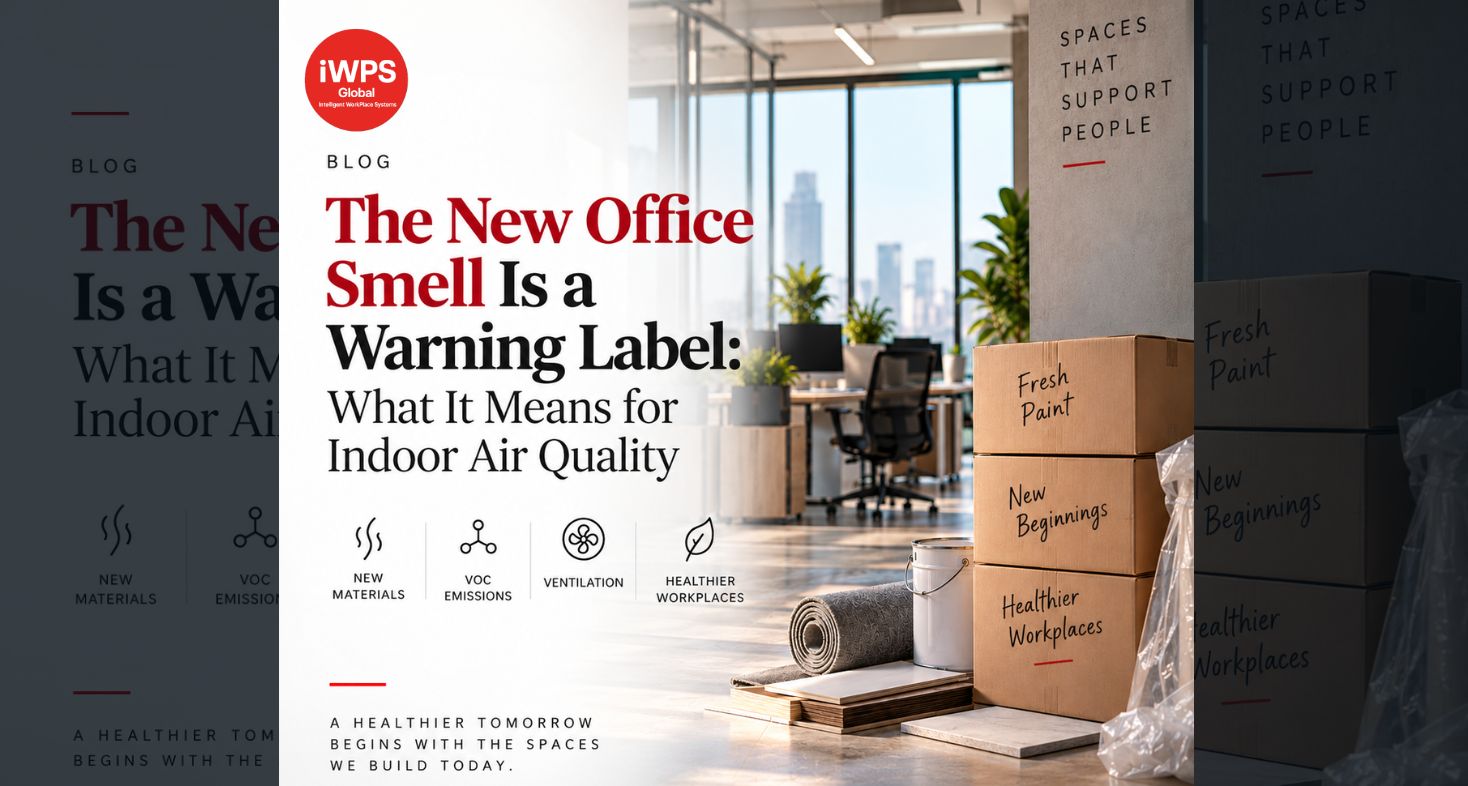
Author: IWPS Global
A newly completed office often smells like success.
Fresh paint. New flooring. Adhesives. Sealants. Carpet backing. Engineered wood. Furniture.
Everything looks finished. The photographs are taken. The client walks through the space. The handover documents are signed.
Then people move in.
The problem is that a space can be visually complete before its indoor environment is ready for occupancy.
That distinctive “new office” smell is not necessarily a sign of quality. It can indicate that recently installed materials are still releasing volatile organic compounds, or VOCs, into the indoor environment.
For workplace leaders, this creates an uncomfortable question:
What if practical completion and environmental readiness are not the same milestone?
A Fit-Out Can Be Finished Without Being Ready
The final stage of an office fit-out is usually measured through visible completion.
Walls are painted.
Furniture is installed.
Lighting is operational.
Flooring is complete.
Snagging is closed.
But materials do not stop emitting compounds simply because the construction programme says the project is finished.
Paints, adhesives, sealants, carpets, composite wood products and other interior materials can contribute to indoor emissions. Those emissions are often highest soon after installation and decline over time.
That means the timing of occupancy matters.
If employees enter the workplace immediately after installation, they may be occupying the space while the emissions curve is still relatively high.
The issue, therefore, is not simply what materials were selected.
It is also:
When was the space occupied, and what happened between installation and occupancy?
The distinction is important because indoor air quality is not created by one product, one ventilation system or one final inspection. It is influenced by decisions made across the entire fit-out process.
The Problem Starts Earlier Than Handover
It is tempting to treat indoor air quality as a commissioning issue.
Choose the materials.
Complete the installation.
Turn on the HVAC system.
Run the building.
Hand over the keys.
However, this sequence leaves very little room for the environment to recover before people arrive.
The better approach is to treat air quality as part of fit-out planning from the beginning.
That means asking questions such as:
- Which materials are likely to contribute to indoor emissions?
- What product specifications are being used?
- Are lower-emission alternatives available?
- How long will materials have to off-gas before occupancy?
- Is a flush-out period included in the programme?
- Who is responsible for verifying indoor air quality?
- What happens if the air does not meet the agreed requirements before handover?
These questions shift indoor air quality from an afterthought to a project-delivery consideration.
How Indoor Air Quality Is Measured
There is a difference between noticing an odour and measuring indoor air quality.
A smell can tell you that something is present.
It cannot, by itself, tell you:
- which compound is responsible,
- at what concentration it is present,
- whether the concentration is acceptable,
- or whether the workplace is ready for occupancy.
The newsletter’s reference framework includes the CDPH Standard Method v1.2, which uses controlled conditions to evaluate emissions from building and furnishing materials. The method includes conditioning and sampling periods rather than relying on an immediate post-installation reading.
That distinction matters.
A freshly installed material may behave very differently immediately after installation than it does after a period of conditioning.
Therefore, the timing of measurement and the timing of occupancy need to be considered together.
Off-Gassing Does Not Stop at Practical Completion
One of the biggest misunderstandings around new interiors is that installation marks the end of material-related emissions.
It does not.
The emissions curve continues after installation.
In general, emissions from newly installed products can be higher immediately after installation and decline over time. The exact behaviour depends on the material, product composition, environmental conditions and other factors.
This creates a practical relationship between three events:
Installation → Off-gassing → Occupancy
If occupancy happens immediately after installation, people enter while the emissions curve is still developing.
If the project allows sufficient time, ventilation and appropriate commissioning before occupancy, the indoor environment has more opportunity to improve.
The fit-out programme therefore becomes part of the indoor-air-quality strategy.
The Three Decisions That Can Change the Handover
Improving indoor air quality after a fit-out does not require treating air as a completely separate problem.
It requires connecting specification, scheduling and commissioning.
1. Build the Flush-Out Into the Programme
Flush-out should not be something the project team remembers when the fit-out is already late.
It needs to exist as an actual activity in the programme.
A period of increased ventilation before occupancy can help remove contaminants from the indoor environment. The exact requirements depend on the project, building systems and applicable standard or certification framework.
The important point is operational:
If the flush-out period is not scheduled, it can easily disappear.
When a project is already under pressure, activities without a defined duration, responsibility and completion requirement are often the first to be compressed.
That is why air quality needs to appear alongside other commissioning activities rather than sitting outside the main delivery programme.
2. Address Emissions at the Specification Stage
Ventilation can help manage indoor pollutants.
But ventilation should not become an excuse for ignoring the source.
Material selection remains important.
Low-emitting paints, adhesives, flooring systems, composite wood products, sealants and furniture can help reduce the quantity of pollutants introduced into the workplace environment.
This changes the question from:
“How do we remove everything after installation?”
to:
“How much are we introducing in the first place?”
That is a fundamentally different design decision.
By the time a material has been installed across an entire floor, replacing it may be expensive and disruptive.
Specification is therefore one of the earliest opportunities to influence indoor environmental quality.
3. Make Air Quality a Commissioning Deliverable
Most modern workplaces have a defined commissioning process.
Electrical systems are tested.
Fire systems are tested.
Mechanical systems are commissioned.
Lifts are inspected.
But indoor air quality can sometimes be reduced to a much simpler assessment:
“Does the office smell okay?”
That is not enough.
A more robust handover process should define:
- what needs to be measured,
- when it should be measured,
- who conducts the assessment,
- what criteria apply,
- what happens if the results are outside the agreed requirements,
- and whether occupancy can proceed.
This makes air quality measurable rather than subjective.
It also creates accountability.
From Fit-Out Completion to Environmental Readiness
A modern workplace handover should not have only one definition of “ready.”
There is a difference between:
Construction readiness
The physical works are complete.
Operational readiness
Building systems, furniture and workplace infrastructure are functional.
Environmental readiness
The workplace provides an indoor environment appropriate for occupancy based on the project’s defined requirements.
These milestones may happen close together.
They should not automatically be treated as identical.
That distinction becomes increasingly important as workplaces become more sophisticated and organisations pay greater attention to employee experience and wellbeing.
A beautifully designed workplace does not deliver its full value if people enter it before the environment is ready.
Why Scheduling Matters More Than It Looks
Indoor air quality can appear to be a technical issue.
In practice, it is also a project-management issue.
Consider a typical fit-out.
The project is already running close to the handover date. Furniture installation finishes late. Cleaning follows immediately. The client has planned employee move-in for Monday.
There is now very little flexibility.
If a flush-out period was never built into the programme, there may be no realistic time available for it.
This is where workplace strategy and fit-out execution intersect.
The question is no longer simply:
“Did we specify the right materials?”
It becomes:
“Did we create enough time for those materials, the building systems and the indoor environment to be ready before people arrived?”
That is a planning question.
Using Data to Plan a Better Handover
This is where workplace project planning can become more intelligent.
Rather than treating the final weeks of a fit-out as a race toward a fixed handover date, project teams can map the sequence of:
Material installation → curing/off-gassing period → ventilation/flush-out → testing → sign-off → occupancy
That sequence can then become part of the wider project programme.
For IWPS Global, this is where the Schedule Planner can support a more structured approach to fit-out delivery.
Instead of treating commissioning as an activity added at the end, project teams can incorporate the required sequence into the delivery programme and make dependencies visible.
The objective is simple:
Don’t schedule occupancy first and try to find time for air quality later.
Build environmental readiness into the path to occupancy.
What This Means for Workplace Leaders
For workplace leaders, facilities teams and real-estate decision-makers, the lesson is broader than VOCs.
Indoor air quality should also be considered when planning office renovation and workplace upgrades, because material selection, ventilation and commissioning can influence the environment people return to.
A workplace is not finished when it looks finished.
The final experience depends on what happens after the visible construction work is complete.
That means workplace handover criteria can include more than:
- aesthetics,
- furniture installation,
- technology,
- lighting,
- HVAC operation,
- and snag closure.
They can also include the environmental conditions people will experience when they actually start using the space.
This is particularly relevant for large workplace programmes where hundreds or thousands of employees may enter a newly fitted environment within a short period.
A small delay in the project schedule can create pressure to compress the final commissioning window.
Planning for that possibility in advance is far easier than trying to recover time after occupancy has already been scheduled.
The Bigger Shift: From Handover to Readiness
The traditional fit-out mindset often ends with a simple question:
“Is the project complete?”
A more human-centred workplace strategy asks another question:
“Is the workplace ready for people?”
Those questions sound similar.
They are not.
A completed workplace can still be going through a transition period.
Materials can still be releasing compounds. Systems may still require balancing. Indoor conditions may still need verification. The building may technically be handed over while the environment is still settling.
The solution is not to make every fit-out unnecessarily complicated.
It is to recognise that occupancy is a performance milestone, not just a calendar date.
Conclusion: A Fresh Office Should Smell Like Readiness, Not Just Newness
The smell of a newly completed office can create an impression of freshness.
But freshness and readiness are not the same thing.
Indoor air quality needs to be considered through the full lifecycle of a fit-out — from material specification and installation to ventilation, commissioning and occupancy.
The strongest approach is therefore not a single final test.
It is a coordinated process:
Specify better materials.
Plan the flush-out.
Commission the air.
Verify before occupancy.
Because a workplace should not simply be finished for the people entering it.
It should be ready for them.
Visit: https://iwpsglobal.com/ || https://blogs.iwpsglobal.com/
Explore: https://wx1.ai/
Connect with us on LinkedIn
Frequently Asked Questions
What causes the new office smell after a fit-out?
The smell can come from recently installed materials and products such as paints, adhesives, sealants, flooring, carpet backing, engineered wood and furniture. Some of these materials can release volatile organic compounds (VOCs) into the indoor environment.
Does a new office smell mean the air quality is unsafe?
Not necessarily. An odour alone cannot determine whether indoor air quality meets a particular health or certification requirement. Air quality needs to be evaluated using appropriate measurements and criteria.
How long should an office wait after a fit-out before occupancy?
There is no single universal waiting period that applies to every office. The appropriate period depends on the materials, building systems, ventilation strategy, applicable standards and project requirements. A planned flush-out and pre-occupancy assessment can help determine readiness.
What is a flush-out in an office fit-out?
A flush-out is a period of increased ventilation intended to remove indoor contaminants before occupants enter the completed space. The exact approach depends on the building and the applicable project or certification requirements.
Can low-VOC materials improve office indoor air quality?
Selecting lower-emitting materials can reduce the amount of pollutants introduced into an indoor environment. However, material selection should be considered alongside ventilation, commissioning and other indoor-air-quality measures.
Should indoor air quality be part of the fit-out handover?
It can be valuable to include indoor air quality within the project’s commissioning and pre-occupancy requirements. This creates a defined process for measurement, verification and sign-off rather than relying only on visual inspection or odour.
Who should be responsible for indoor air quality before office occupancy?
Responsibility should be clearly defined within the project delivery and commissioning process. Depending on the project, this can involve workplace strategists, project managers, MEP teams, contractors, commissioning professionals and facilities teams.
Final CTA
Your workplace handover should not end when the fit-out looks complete.
It should end when the space is ready for people.
At IWPS Global, workplace strategy connects design, technology, project delivery and workplace performance to help organisations make more informed decisions about the environments they create.
Ready to rethink your next workplace handover?
Talk to IWPS Global about building readiness into your workplace strategy.