
 By Archie J Abraham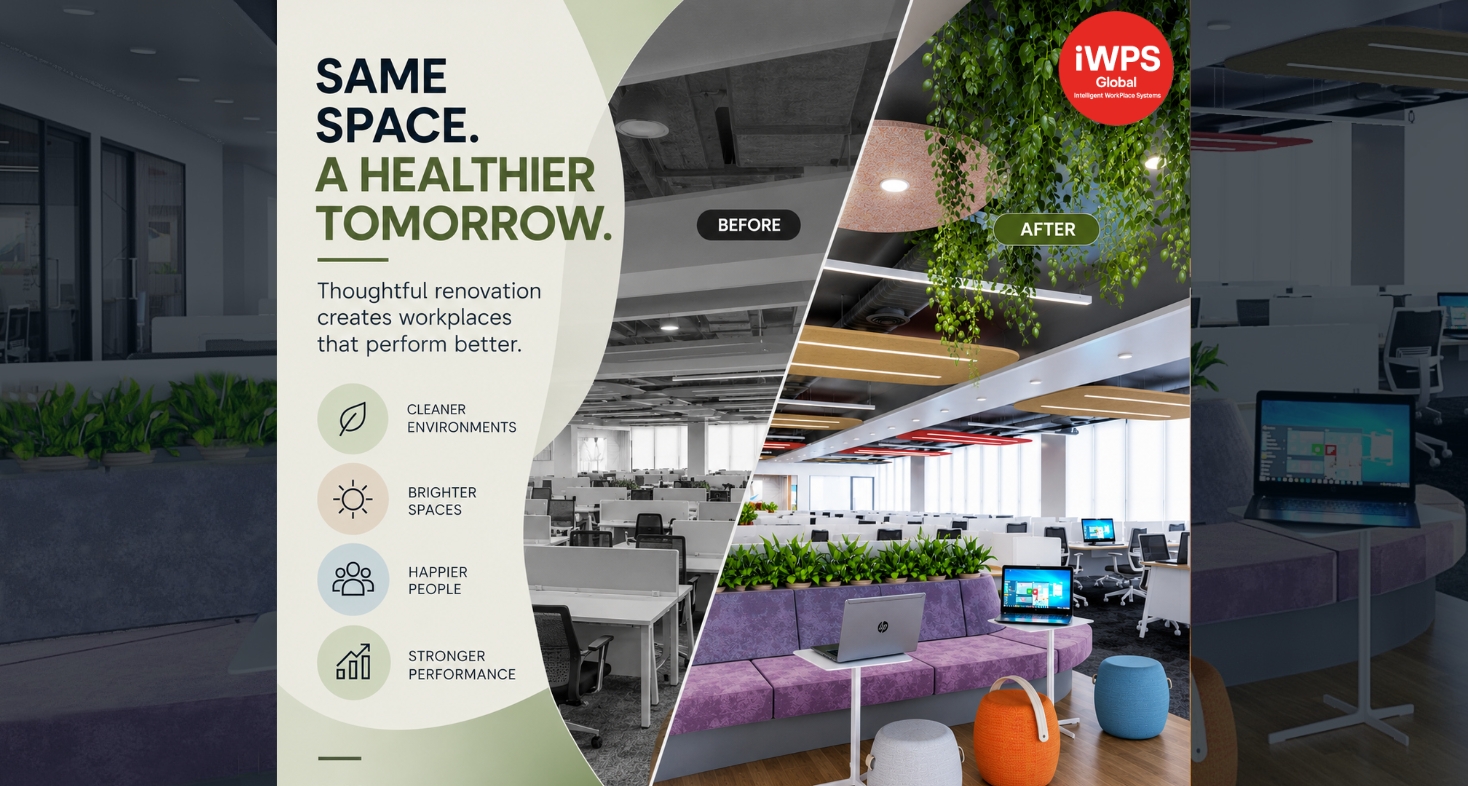
A renovated office can look completely different.
A renovated office can look completely different. It may have new furniture, finishes, meeting rooms and layouts. However, a visual upgrade does not automatically create a healthier workplace.
But does a newer office automatically mean a healthier workplace?
Not necessarily.
Office renovation can affect many parts of the workplace. These include indoor air quality, ventilation, thermal comfort, lighting and acoustics.
For example, construction materials can release VOCs and particulate matter. Changes to the layout or building systems can also affect workplace performance.
Therefore, renovation is not only a design decision. It is also a workplace health decision.
Yet renovation decisions are often driven primarily by cost, aesthetics, functionality and sustainability. Health can become an afterthought.
A 2026 study published in Buildings highlights this gap and proposes a health-oriented assessment framework specifically for office interior renovation.
The central idea is simple:
Workplace health should be designed into renovation decisions—not checked after the renovation is complete.
Why Office Renovation Needs a Different Approach?
Office interiors are not renovated once and forgotten.
Over time, organisations restructure and work patterns change. At the same time, technology evolves and tenant needs shift. As workplace strategies change, office spaces need to adapt as well.
The research notes that office interiors in many metropolitan environments can undergo renovation cycles of around five to ten years, sometimes more frequently. This makes renovation a recurring part of the building lifecycle rather than a one-time event.
Every renovation therefore creates an opportunity to improve the workplace—or unintentionally introduce new problems.
There is another challenge. Most green building certification systems focus on the whole building or the design stage.
Systems such as LEED, WELL and BREEAM have helped advance healthy and sustainable buildings. However, they offer less guidance for recurring interior renovation and fit-out.
This matters because office spaces change throughout their lifecycle.
This creates a practical question:
How should workplace teams prioritise health when deciding what to change during a renovation?
Four Things Matter Most
To answer this question, the study developed a health-oriented assessment framework.
The researchers reviewed existing literature and consulted experts from different fields. They then used Fuzzy Delphi screening and AHP weighting to refine the framework.
The final framework contains four dimensions and 18 indicators.
| Dimension | Weight |
| Environmental Quality | 39.2% |
| Safety Management | 23.0% |
| Functional Usability | 21.1% |
| Resource Efficiency & Circularity | 16.7% |
The ranking tells us something important:
The immediate conditions experienced by people inside the workplace matter most.
1. Environmental Quality Comes First
Environmental Quality received the highest weighting at 39.2%.
It covers:
- Indoor air quality
- Thermal comfort
- Ventilation effectiveness
- Lighting
- Acoustics
Why does this matter? People experience these conditions every day.
A visually impressive office with poor ventilation is still a poor workplace. Likewise, an energy-efficient office with uncomfortable temperatures can create a poor employee experience.
Therefore, the research places indoor environmental quality at the centre of health-oriented renovation.
A visually impressive office with poor ventilation is still a poor workplace.
A sustainable office with uncomfortable temperatures can still create an unpleasant employee experience.
The research therefore places indoor environmental quality at the centre of health-oriented renovation.
Indoor Air Quality Is the Biggest Priority
Of the 18 indicators assessed, indoor air quality management ranked first.
This is particularly relevant during renovation.
During renovation, construction activities and new materials can introduce pollutants. Changes to the layout or HVAC system can also affect ventilation and air exchange.
For this reason, indoor air quality management ranked first among the 18 indicators studied.
For a closer look at what happens after new materials are installed, see our guide to the new office smell and fit-out handover.
It has a direct link to occupant health and exposure risks.
So, don’t ask only:
“Which materials look best?”
Also ask:
“What will these materials and construction activities do to the indoor environment?”
So instead of asking only:
“Which materials look best?”
Renovation teams should also ask:
“What will these materials and construction activities do to the indoor environment?”
That is a much stronger workplace strategy question.
HVAC and Thermal Comfort Matter Too
HVAC performance is another major priority in the research. Thermal comfort also ranks highly.
Why? HVAC does more than control temperature. It affects ventilation, air quality, thermal comfort and energy performance.
As a result, an HVAC upgrade can support both health and sustainability.
The goal is not simply to install an efficient system. Instead, the goal is to create an environment that performs well for the people using it.
During renovation, upgrading or reconfiguring HVAC systems can therefore create both health and sustainability benefits.
The goal isn’t simply to install an efficient system.
It is to create an environment that performs well for the people using it.
Space Planning Is Part of Workplace Health
Health-oriented renovation also extends beyond air and building systems.
Space-friendly layout was one of the highest-ranked indicators.
The reason is simple: people don’t experience a workplace as a collection of technical specifications.
They experience it through:
- How easily they move through it
- Whether spaces support different work activities
- How adaptable the environment is
- Whether the layout supports daily work
A renovation should therefore ask not only:
“How much space do we have?”
but also:
“How effectively does this space support the people using it?”
The Most Important Decision May Happen Before Construction
Another high-priority indicator identified by the research is preliminary assessment and renovation planning.
This is where many renovation projects can improve.
Before designing the new workplace, teams should understand the existing one.
That means assessing:
- Existing indoor conditions
- HVAC performance
- Current space usage
- Potential health risks
- Operational requirements
- Renovation constraints
The earlier these factors are understood, the more effectively they can influence the design.
The research specifically identifies early assessment and planning as a critical part of health-oriented renovation decision-making.
Where Digital Twins Can Strengthen the Process
This is where workplace technology becomes particularly useful.
A Digital Twin can create a real-time 3D digital representation of the workplace, bringing together information such as occupancy patterns, environmental conditions and space utilisation.
For renovation teams, this can provide a better way to understand the existing workplace before making physical changes.
Teams can use the model to:
- Visualise existing conditions
- Understand occupancy patterns
- Examine environmental information
- Explore potential renovation scenarios
- Compare options before construction
This supports the research’s emphasis on early assessment and informed decision-making.
Instead of making every decision on a static floor plan, teams can explore how the workplace behaves as a system.
The objective isn’t to replace architects, engineers or facility managers.
It is to give them better information before they commit to expensive physical changes.
From Renovation Project to Workplace Performance Strategy
The research proposes a practical decision-making process:
- Define renovation alternatives
Identify the realistic options available. - Assess each alternative
Evaluate them against the 18 health-oriented indicators. - Apply the weighting
Prioritise the factors that matter most. - Compare the options
Understand the health, usability, safety and sustainability trade-offs. - Make the decision
Balance performance against budget, schedule and operational constraints.
This is important because real renovation projects rarely have unlimited budgets or perfect solutions.
The goal is not to find a theoretical perfect workplace.
It is to make the best-informed decision within real-world constraints.
What Workplace Leaders Should Take Away?
For facility managers, workplace strategists and business leaders, the message is straightforward:
Start with assessment, not aesthetics.
Understand the existing workplace before deciding what needs to change.
Put indoor environmental quality high on the agenda.
Air quality, ventilation and thermal comfort directly influence workplace conditions.
Design around how people actually work.
Space planning should support usability, adaptability and different work activities.
Treat renovation as an operational process.
Safety, construction activities and disruption are part of workplace performance.
Use data before committing capital.
Digital tools such as Digital Twins can help teams understand conditions and explore scenarios before construction begins.
The Future of Office Renovation Is Not Just “New”
The research makes an important distinction.
A renovation changes the physical workplace.
A better renovation improves how that workplace performs.
The proposed framework is not intended to replace LEED, WELL, BREEAM or other established certification systems. Instead, it complements them by focusing specifically on the recurring interior renovation stage, where health and workplace performance can change over time.
And that is ultimately the bigger shift.
The workplace shouldn’t be assessed only when it is first designed.
It should be understood and improved throughout its lifecycle.
Final Takeaway
A successful office renovation should do more than make a workplace look modern.
It should make the workplace:
Healthier.
Safer.
Healthier, safer, and designed for greater comfort, usability, and efficiency.
The research places Environmental Quality at the top of the priority list, with Indoor Air Quality Management emerging as the highest-ranked individual indicator.
That gives workplace leaders a clear starting point.
Don’t just renovate the office.
Understand how it performs.
Design around the people using it.
And make workplace health part of the renovation strategy from day one.
Visit: https://iwpsglobal.com/ || https://blogs.iwpsglobal.com/
Explore: https://wx1.ai/
Connect with us on LinkedIn
Frequently Asked Questions
What are the four dimensions of health-oriented office renovation?
The framework identifies Environmental Quality, Safety Management, Functional Usability, and Resource Efficiency & Circularity.
What is the most important factor in healthy office renovation?
Indoor air quality management ranked first among the 18 indicators evaluated by the study.
Why is HVAC important during office renovation?
HVAC performance influences ventilation, indoor air quality, thermal comfort and energy efficiency, making it both a health and sustainability consideration.
Can Digital Twins support office renovation?
Yes. A Digital Twin can help teams visualise workplace conditions, understand occupancy and environmental patterns, and explore renovation scenarios before physical construction.
Does this framework replace LEED or WELL?
No. The research positions the framework as complementary to existing certification systems, addressing the specific gap around recurring interior renovation and fit-out.
[…] air quality should also be considered when planning office renovation and workplace upgrades, because material selection, ventilation and commissioning can influence the […]